
Resources
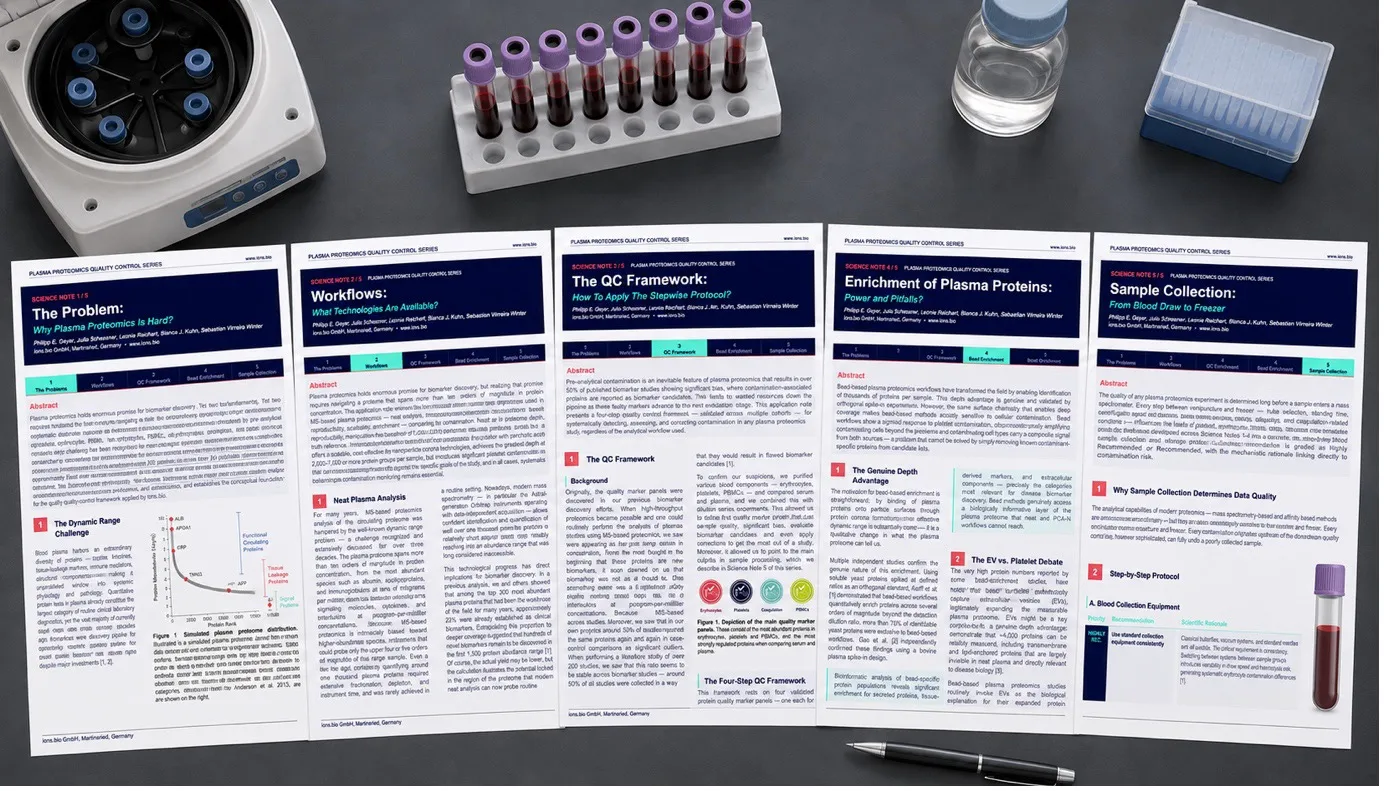
Free science notes on MS-based proteomics
- 5 notes
Application notes from our lab
-

Ocular humor proteomic profiling
Contamination-aware interpretation of aqueous and vitreous humor
- Aqueous humor reaches ~1,600 protein groups across more than seven orders of magnitude; vitreous humor ~6,900 across more than six
- Both matrix and donor effects shape the ocular fluid proteome
- Contamination is inevitable — the goal is quantification, monitoring and correction, not elimination
Peer-reviewed publications, co-authored by our team
-
Blood proteomics: insights from public data.
The circulating blood proteome comprises soluble and cellular components that reflect physiological and pathological states across tissues. Advances in mass spectrometry and affinity-based proteomics have improved sensitivity and throughput, enabling the generation of public blood proteomics resources. However, comprehensive assessments of these datasets remain limited. This work reviews the cellular and molecular complexity of publicly available blood proteomics data, recent methodological developments, and the complementarity of diverse data sources across the abundance range, while outlining remaining challenges for translating blood proteomics into personalized medicine.
Read paper ↗ -
Translational bottlenecks in blood-based proteomics.
The translation of blood-based proteomics into healthcare is no longer constrained primarily by technological limitations, but by unresolved challenges in standardization, validation, and implementation. In this Commentary, we identify four structural bottlenecks at the current translational inflection point that limit the opportunities for the adoption of multi-protein blood biomarkers in routine clinical care: lack of harmonized reference frameworks, uncertainty around fit-for-purpose biological resolution, complexity in validating multi-analyte and algorithm-based tests, and misalignment between the design of discovery workflows and clinical requirements. We argue that progress will depend on shifting from exploratory profiling toward decision-oriented proteome analytics, with early alignment across academic, regulatory, clinical, and technical domains. Establishing coherent validation pathways for clinically actionable use cases will be essential to enable reliable integration of proteomics into healthcare.
Read paper ↗ -
Limited impact of column chemistry and length on proteome coverage under high-speed DIA.
The evolution of mass spectrometry (MS)-based proteomics has been driven by continuous technological advances in sample preparation, liquid-phase separations, instrumentation, and data acquisition. Chromatographic performance has been recognized as a contributing factor to identification depth, particularly on earlier-generation MS platforms. Recent advances in MS sampling speed and sensitivity now raise the question of how strongly chromatographic quality continues to determine overall proteome coverage. We investigate how column chemistry and length influence proteome coverage and chromatographic selectivity under modern DIA conditions, and whether traditional optimization priorities still apply. Spanning a matrix of experiments with five distinct stationary phases, including C18 chemistries, C8, and Phenyl-Hexyl, across eight column lengths (40-140 mm), we evaluate protein identification performance using data-independent acquisition (DIA) on the Orbitrap Astral mass spectrometer. Despite differences in stationary-phase chemistry and column length, we observed remarkably convergent proteome coverage metrics. All C18 and C8 phases consistently achieved over 150,000 precursor- and approximately 9,000 protein group identifications, regardless of column length variations. While retention fingerprints persisted across chemistries, these chromatographic differences did not translate into meaningful variations in proteome coverage under high-speed acquisition conditions at 200 Hz. Within the range of modern sub-2 μm reversed-phase materials tested, identification depth showed limited dependence on column chemistry and length, suggesting that for state-of-the-art stationary phases, method development priorities may increasingly favor operational robustness, throughput, and reproducibility over traditional separation optimization.
Read paper ↗ -
Bridging the gap: A systematic approach to integrating serum and plasma proteomic datasets for biomarker studies.
Serum and plasma are widely used in proteomic biomarker discovery, but differences between their proteomes have hindered the integration of data from the two specimen types. Here, we describe a computational approach for bridging between serum and plasma proteomic measurements derived from the aptamer-based SomaScan assay. We aimed to enable cross-specimen data utilization in the context of the PROphet model designed to predict immunotherapy outcomes based on 388 plasma proteomic biomarkers. Proteomic profiling of 7289 proteins was performed on 177 matched serum-plasma sample pairs from cancer patients across three distinct cohorts. Remarkably, 91.6% of the proteins showed correlation (p-value < 0.05) between serum and plasma protein levels, highlighting the feasibility of serum-plasma bridging. Linear scaling factors derived from matched serum-plasma sample pairs were consistent across the three cohorts, suggesting that the scaling factors are generalizable. Notably, the PROphet model maintained its predictive power when applied to scaled serum proteomic measurements. Specifically, clinical benefit predictions and survival stratification based on scaled serum proteomic measurements were similar to those based on plasma proteomic measurements. Our study demonstrates the feasibility of generalizing plasma-based predictors to serum samples through appropriate bridging strategies, paving the way for integrating serum and plasma datasets.
Read paper ↗ -
Multi-cohort, cross-species urinary proteomics reveals signatures of LRRK2 dysfunction in Parkinson's disease.
Pathogenic mutations in Leucine-rich repeat kinase 2 (LRRK2) are the predominant genetic cause of Parkinson’s disease (PD) and often increase kinase activity, making LRRK2 inhibitors promising treatment options. Although LRRK2 kinase inhibitors are advancing clinically, non-invasive readouts of LRRK2-linked pathway modulation remain limited. Profiling urinary proteomes from 1215 individuals across three cohorts and integrating whole-genome sequencing from >500 participants to map genotype–proteome associations, we identified 177 urinary proteins associated with pathogenic LRRK2, enriched for lysosomal/glycosphingolipid, immune, and membrane-trafficking pathways. Machine learning narrowed the features to a cohort-agnostic 30-protein panel that classified G2019S carriers with a mean ROC AUC of 0.91 across independent tests. To evaluate translation, we performed multi-organ and urinary proteomics in rat gain- and loss-of-function models (BAC-LRRK2G2019S and Lrrk2KO) and after Lrrk2 inhibition (MLi-2 and PF-475), revealing tissue-specific responses—strongest in kidney—and cross-species overlap, including 24 brain proteins detectable in human urine. Rat-derived perturbations predicted LRRK2 mutation status in patients (AUC 0.75) and reversed with Lrrk2 inhibition, supporting their pharmacodynamic utility. Together, our findings establish urine as a scalable, non-invasive matrix that captures systemic and brain-relevant consequences of LRRK2 dysfunction and nominate candidate pharmacodynamic markers set to support LRRK2-directed trials.
Read paper ↗ -
The PRECISE European initiative for cancer-vulnerability mapping and prediction
PRECISE is a European initiative to move cancer research beyond descriptive atlases toward predictive, mechanistically informed models of tumor vulnerability. By integrating patient cohorts, disease-relevant model systems, perturbation biology, multimodal profiling and artificial intelligence-driven inference, the PRECISE consortium aims to learn generalizable and predictive rules that govern genetic dependencies and synthetic lethality.
Read paper ↗ -
Large-scale proteomics across neurological disorders uncovers biomarker panel and targets in multiple sclerosis
The study applies a high-throughput mass-spectrometry workflow to cerebrospinal-fluid samples from more than 5,000 individuals across major neurological disorders. It maps effects associated with blood–CSF barrier impairment, age and sex, and distinguishes shared from disease-specific proteomic signatures. The analysis yields a 22-protein panel that improves differential diagnosis of multiple sclerosis and highlights potential therapeutic targets.
Read paper ↗ -
Clonal haematopoiesis of indeterminate potential and mortality in coronary artery disease
Background and aims: Clonal haematopoiesis of indeterminate potential (CHIP) has been associated with cardiovascular risk, but its prognostic relevance and mechanistic role in coronary artery disease (CAD) remains incompletely understood. This study investigated the association between CHIP and all-cause mortality in CAD and explored the cellular and molecular mechanisms, focusing on TET2 mutations. Methods: Targeted deep sequencing of 13 CHIP driver genes in 8612 patients with angiographically confirmed CAD was performed. Clonal haematopoiesis of indeterminate potential carriers (variant allele frequency ≥2%) were propensity-score matched 1:1 to non-carriers. Mortality was assessed over 3 years. Mechanistic insights were derived from post-mortem high-sensitivity plaque proteomics (MISSION), RNA sequencing from carotid plaques (Athero-Express), monocyte-derived macrophage transcriptomes (STARNET), and CRISPR/Cas9-generated TET2+/- macrophages in vitro. Results: Clonal haematopoiesis of indeterminate potential was associated with increased 3-year mortality (hazard ratio 1.39, 95% confidence interval 1.16-1.65, P < .001) in 2389 matched pairs. Mutations in TET2, ASXL1, DNMT3A, JAK2, PPM1D, SF3B1, SRSF2, and U2AF1 individually conferred higher mortality risk. In human plaques, CHIP mutations were found in lesional macrophages. TET2 CHIP carriers showed increased necrotic core size, inflammation, and reduced plaque stability. Multi-omics profiling revealed up-regulation of lipid metabolism and inflammatory pathways. TET2+/- macrophages exhibited increased LDLR expression and lipid uptake, linked to enhanced chromatin accessibility at the LDLR promoter. These findings were confirmed in carotid plaques, which showed increased LDLR and inflammasome-related gene expression in TET2 CHIP carriers. Conclusions: Clonal haematopoiesis of indeterminate potential is a predictor of mortality in CAD patients. TET2 mutations promote a pro-atherogenic macrophage phenotype via LDLR up-regulation and inflammatory activation, linking epigenetic dysregulation to adverse outcomes in CAD.
Read paper ↗ -
Kinase inhibition rewires the HLA-I immunopeptidome in chronic myeloid leukemia
Immunotherapy offers promising opportunities to improve immune-mediated control of chronic myeloid leukemia (CML), but its success depends on identifying antigens uniquely associated with CML. Protein kinases regulate signaling and protein turnover, influencing which peptides are presented on HLA molecules. Although earlier studies suggested that kinase inhibition can alter immune recognition of cancer cells, the underlying mechanisms remain unclear. In this study, we investigated whether targeting key kinases could reshape the CML immunopeptidome. The pharmacological inhibition of SFK, JNK, and BCR-ABL caused broad remodeling of antigen presentation, affecting the display of 4,000 HLA-I ligands. By integrating immunopeptidomics, phospho-immunopeptidomics, and proteomics, we identified three complementary mechanisms regulating antigen display. Comparing benign hematologic tissues with CML samples revealed about 90 CML-specific peptides that became more prominent after SFK or JNK inhibition. Overall, this work provides a quantitative, multi-omic framework to rationally combine kinase inhibitors with immunotherapy to boost antigen visibility and antileukemic immunity.
Read paper ↗ -
C-COMPASS: a user-friendly neural network tool profiles cell compartments at protein and lipid levels
C-COMPASS is an open-source application for analyzing fractionation-based spatial proteomics and lipidomics data. Its neural-network regression model predicts continuous distributions across cellular compartments, captures multilocalized molecules and incorporates abundance changes between conditions. Applications to metabolic perturbations demonstrate its ability to quantify organelle composition and remodeling through a user-friendly interface.
Read paper ↗ -
Pre-analytical drivers of bias in bead-enriched plasma proteomics.
Bead-based enrichment is a promising strategy to improve depth in plasma proteomics by overcoming the dynamic range barrier. However, its robustness against pre-analytical variation has not been sufficiently characterized. Here, we systematically evaluate five plasma proteomics workflows, including three bead-based methods, a neat workflow, and a precipitation protocol using spike-ins of low-abundance proteins and defined cellular contaminants. We find that bead-based approaches enhance detection of low-abundance proteins but can be highly susceptible to systematic bias from platelet and PBMC contamination. This can inflate results by thousands of proteins, potentially explaining some of the high literature-reported numbers. A perchloric acid-based workflow shows resistance to erythrocyte and platelet-derived contamination. We investigate how centrifugation conditions, anticoagulant choice, and buffer-bead combinations modulate contamination profiles and demonstrate that bias can be mitigated by optimized sample handling. Altogether, we identify more than 13,000 different protein groups, including cellular components from the circulating proteome. Our results provide a quantitative framework for assessing workflow performance under variable sample quality and offer guidance for both biomarker discovery and quality control in clinical proteomics studies.
Read paper ↗ -
A standardized framework for circulating blood proteomics.
The circulating blood proteome holds immense potential for biomarker discovery and understanding disease mechanisms. Notable advances in mass spectrometry and affinity-based technologies have been made, but data integration across studies and platforms is hindered by the absence of unified analytical standards. This limitation impedes comprehensive exploration of human biology across diverse phenotypes and cohorts as well as the translation of findings into clinical applications. The disparities between datasets, stemming from a combination of factors related to differences in sample collection, pre-analytical handling, measurement methods and instrumentation, further complicate data integration. In this Perspective, we outline key challenges in blood-based proteomics and propose actionable strategies. Central to our recommendations are high-quality, technology-agnostic reference samples, which can bridge disparate datasets and enable robust cross-study comparisons. By fostering interconnected investigations across proteomic technologies, blood sample collections, clinical phenotypes and different populations, these references will accelerate the field and its translation.
Read paper ↗ -
Regulatory T cells in the mouse hypothalamus control immune activation and ameliorate metabolic impairments in high-calorie environments
The hypothalamus is central to systemic metabolic regulation, but calorie-rich diets activate immune responses in this brain region and contribute to obesity and type 2 diabetes. The study identifies regulatory T cells as important controllers of hypothalamic immunity. High-fat, high-sugar feeding activated local CD4-positive T cells, macrophages and microglia while decreasing hypothalamic regulatory T cells. Transcriptomic analysis showed a Th1-like state in hypothalamic CD4-positive cells. Regulatory-T-cell depletion intensified immune activation, whereas their transfer or expansion reduced inflammation and improved metabolic parameters, demonstrating that these cells can counteract diet-induced hypothalamic and systemic dysfunction.
Read paper ↗ -
NIS-Seq enables cell-type-agnostic optical perturbation screening
Optical pooled screening links image-based cellular phenotypes to genetic perturbations, but earlier approaches depend on cytosolic barcode transcripts and are difficult to apply to small, dense or weakly transcriptional cells. The authors developed Nuclear In-Situ Sequencing (NIS-Seq), which transcribes guide-RNA barcode sequences directly from genomic DNA after imaging and identifies them through padlock-based three-colour in situ sequencing. The method enables pooled optical perturbation screening across diverse nucleated cell types.
Read paper ↗ -
Deep Visual Proteomics maps proteotoxicity in a genetic liver disease
Protein misfolding diseases such as alpha-1-antitrypsin deficiency have poorly resolved cellular progression in human tissue. The authors combine Deep Visual Proteomics, single-cell analysis and machine learning in intact liver biopsies to reconstruct hepatocyte stress across fibrosis stages. The spatial proteomic maps identify molecular trajectories of proteotoxicity and reveal disease-associated changes at near-single-cell resolution.
Read paper ↗ -
Decoding adult murine pancreatic islet cell diversity through cell type-resolved proteomics and phosphoproteomics
Read paper ↗ -
An accessible workflow for high-sensitivity proteomics using parallel accumulation-serial fragmentation (PASEF)
Deep and accurate proteome analysis is crucial for understanding cellular processes and disease mechanisms; however, it is challenging to implement in routine settings. In this protocol, we combine a robust chromatographic platform with a high-performance mass spectrometric setup to enable routine yet in-depth proteome coverage for a broad community. This entails tip-based sample preparation and pre-formed gradients (Evosep One) combined with a trapped ion mobility time-of-flight mass spectrometer (timsTOF, Bruker). The timsTOF enables parallel accumulation-serial fragmentation (PASEF), in which ions are accumulated and separated by their ion mobility, maximizing ion usage and simplifying spectra. Combined with data-independent acquisition (DIA), it offers high peak sampling rates and near-complete ion coverage. Here, we explain how to balance quantitative accuracy, specificity, proteome coverage and sensitivity by choosing the best PASEF and DIA method parameters. The protocol describes how to set up the liquid chromatography-mass spectrometry system and enables PASEF method generation and evaluation for varied samples by using the py_diAID tool to optimally position isolation windows in the mass-to-charge and ion mobility space. Biological projects (e.g., triplicate proteome analysis in two conditions) can be performed in 3 d with ~3 h of hands-on time and minimal marginal cost. This results in reproducible quantification of 7,000 proteins in a human cancer cell line in quadruplicate 21-min injections and 29,000 phosphosites for phospho-enriched quadruplicates. Synchro-PASEF, a highly efficient, specific and novel scan mode, can be analyzed by Spectronaut or AlphaDIA, resulting in superior quantitative reproducibility because of its high sampling efficiency.
Read paper ↗ -
A Novel Hybrid High-Speed Mass Spectrometer Allows Rapid Translation From Biomarker Candidates to Targeted Clinical Tests Using (15)N-Labeled Proteins
Read paper ↗ -
Gliomas phenocopy an inborn error of metabolism to drive neuronal activity and tumor growth
High-grade gliomas were found to accumulate and secrete the creatine-pathway intermediate guanidinoacetate because of imbalanced pathway enzyme activity. This metabolic state resembles guanidinoacetate methyltransferase deficiency, an inborn error of metabolism associated with neuronal hyperexcitability. Tumor-derived guanidinoacetate increases neuronal activity and promotes glioma growth, revealing a metabolic mechanism linking glioma cells to neural-circuit activation.
Read paper ↗ -
Pleiotropic Effects of Metformin on the Chemotherapy Response of HPV-Positive Cancer Cells
This study examines how metformin affects HPV-positive cancer cells alone and in combination with chemotherapy. Metformin suppresses growth through mechanisms that are not explained solely by E6/E7 downregulation and alters cell-cycle and regulatory proteins differently from targeted viral-oncogene repression. It can also modify responses to etoposide and cisplatin, with outcomes depending on treatment conditions and p53 status.
Read paper ↗ -
Redefining ALS: Large-scale proteomic profiling reveals a prolonged pre-diagnostic phase with immune, muscular, metabolic, and brain involvement
Using prospective cohorts with blood collected up to decades before diagnosis, this study profiles the pre-diagnostic proteome of amyotrophic lateral sclerosis. Protein changes indicate a prolonged disease phase involving immune, muscular, metabolic and nervous-system processes well before clinical recognition. The work proposes candidate biomarkers and reframes ALS as a multisystem disorder with an extended biological onset.
Read paper ↗ -
Dynamic Organellar Mapping in yeast reveals extensive protein localization changes during ER stress
Label-free Dynamic Organellar Mapping was applied to yeast undergoing endoplasmic-reticulum stress to measure proteome-wide changes in native protein localization. Hundreds of proteins redistributed between compartments, including broad retention of secretory-pathway proteins in the ER and changes involving lipid droplets and quality-control pathways. The study demonstrates extensive spatial reorganization as part of the cellular stress response.
Read paper ↗ -
Design principles for cyclin K molecular glue degraders
Molecular glue degraders are an effective therapeutic modality, but their design principles are not well understood. Recently, several unexpectedly diverse compounds were reported to deplete cyclin K by linking CDK12–cyclin K to the DDB1–CUL4–RBX1 E3 ligase. Here, to investigate how chemically dissimilar small molecules trigger cyclin K degradation, we evaluated 91 candidate degraders in structural, biophysical and cellular studies and reveal all compounds acquire glue activity via simultaneous CDK12 binding and engagement of DDB1 interfacial residues, in particular Arg928. While we identify multiple published kinase inhibitors as cryptic degraders, we also show that these glues do not require pronounced inhibitory properties for activity and that the relative degree of CDK12 inhibition versus cyclin K degradation is tuneable. We further demonstrate cyclin K degraders have transcriptional signatures …
Read paper ↗ -
Proteomic Characterization of Undifferentiated Small Round Cell Sarcomas with EWSR1-and CIC:: DUX4-Translocations Reveals Diverging Tumor Biology and Distinct Diagnostic Markers
Undifferentiated small round cell sarcomas of bone and soft tissue (USRS) are a group of tumors with heterogenic genomic alterations sharing similar morphology. In the present study, we performed a comparative large-scale proteomic analysis of USRS (n=42) with diverse genomic translocations including classic Ewing sarcomas with EWSR1::FLI1 fusions (n=24) or EWSR1::ERG – fusions (n=4), sarcomas with an EWSR1 – rearrangement (n=2), CIC::DUX4 fusion (n=8), as well as tumors classified as USRS with no genetic data available (n=4). Proteins extracted from formalin-fixed, paraffin-embedded (FFPE) pretherapeutic biopsies were analyzed qualitatively and quantitatively using shot gun mass spectrometry (MS). More than 8000 protein groups could be quantified using data-independent acquisition. Unsupervised hierarchical cluster analysis based on proteomic data allowed stratification of the 42 cases …
Read paper ↗ -
The Circulating Proteome─ Technological Developments, Current Challenges, and Future Trends
Recent improvements in proteomics technologies have fundamentally altered our capacities to characterize human biology. There is an ever-growing interest in using these novel methods for studying the circulating proteome, as blood offers an accessible window into human health. However, every methodological innovation and analytical progress calls for reassessing our existing approaches and routines to ensure that the new data will add value to the greater biomedical research community and avoid previous errors. As representatives of HUPO’s Human Plasma Proteome Project (HPPP), we present our 2024 survey of the current progress in our community, including the latest build of the Human Plasma Proteome PeptideAtlas that now comprises 4608 proteins detected in 113 data sets. We then discuss the updates of established proteomics methods, emerging technologies, and investigations of proteoforms …
Read paper ↗ -
Cell Type-Agnostic Optical Perturbation Screening Using Nuclear In-Situ Sequencing (NIS-Seq)
Genome-scale perturbation screening is widely used to identify disease-relevant cellular proteins serving as potential drug targets. However, most biological processes are not compatible with commonly employed perturbation screening methods, which rely on FACS- or growth-based enrichment of cells. Optical pooled screening instead uses fluorescence microscopy to determine the phenotype in single cells, and subsequently to identify individual perturbagens in the same cells. Published methods rely on cytosolic detection of endogenously expressed barcoded transcripts, which limits application to large, transcriptionally active cell types, and often relies on local clusters of clonal cells for unequivocal barcode assignment, thus precluding genome-scale screening for many biological processes. Nuclear In-Situ Sequencing (NIS-Seq) solves these shortcomings by creating bright sequencing signals directly from nuclear genomic DNA, enabling screening any nucleus-containing cell type at high density and high library complexity. We benchmark NIS-Seq by performing three genome-scale optical screens in live cells, identifying key players of inflammation-related cellular pathways.
Read paper ↗ -
Synthetic RIG-I agonist-mediated cancer immunotherapy synergizes with MAP kinase inhibition against BRAF-mutated melanoma
The implementation of targeted molecular therapies and immunotherapy in melanoma vastly improved the therapeutic outcome in patients with limited efficacy of surgical intervention. Nevertheless, a large fraction of patients with melanoma still remain refractory or acquire resistance to these new forms of treatment, illustrating a need for improvement. Here, we report that the clinically relevant combination of mitogen-activated protein (MAP) kinase pathway inhibitors dabrafenib and trametinib synergize with RIG-I agonist-induced immunotherapy to kill BRAF-mutated human and mouse melanoma cells. Kinase inhibition did not compromise the agonist-induced innate immune response of the RIG-I pathway in host immune cells. In a melanoma transplantation mouse model, the triple therapy outperformed individual therapies. Our study suggests that agonist-induced activation of RIG-I with its synthetic ligand 3pRNA …
Read paper ↗ -
Sensing endogenous RNA in living human cells using a CRISPR-activated protease
Most techniques used to detect specific mRNAs in eukaryotic cells require to extract nucleic acids and thereby kill the cells. A programmable sensor for monitoring endogenous transcripts in living cells, in contrast, would enable to enrich living cells based on a specific transcription or splicing event, and studying these cells by live microscopy or sequencing methods requiring intact cells. We have engineered CRISPR-READ, a live cell RNA detector based on the CRISPR-associated Lon protease CalpL and a cA4-producing Type III CRISPR system. Upon RNA-programmable RNA sensing, CRISPR-READ produces an orthogonal second messenger, which leads to the cleavage of a dual FRET / localization reporter compatible with FACS sorting and live microscopy. Using this genetically encoded sensing circuit as a readout for a genome-wide CRISPR perturbation screen, we identified an extended Type-I interferon signaling cascade; RNA-Seq on sensor-sorted cells enabled unbiased identification of correlated stochasticity in gene expression across single cells.
Read paper ↗ -
Personalised human albumin in patients with cirrhosis and ascites: design and rationale for the ALB-TRIAL - a randomised clinical biomarker validation trial
Human albumin is used in the treatment of complications of cirrhosis. However, the use of long-term human albumin administration is costly and resource demanding for both patients and healthcare systems. A precision medicine approach with biomarkers to predict human albumin treatment response, so-called predictive biomarkers, could make this a viable treatment option in patients with cirrhosis and ascites.
Read paper ↗ -
Bridging the Gap From Proteomics Technology to Clinical Application: Highlights From the 68th Benzon Foundation Symposium.
The 68th Benzon Foundation Symposium brought together leading experts to explore the integration of mass spectrometry–based proteomics and artificial intelligence to revolutionize personalized medicine. This report highlights key discussions on recent technological advances in mass spectrometry–based proteomics, including improvements in sensitivity, throughput, and data analysis. Particular emphasis was placed on plasma proteomics and its potential for biomarker discovery across various diseases. The symposium addressed critical challenges in translating proteomic discoveries to clinical practice, including standardization, regulatory considerations, and the need for robust “business cases” to motivate adoption. Promising applications were presented in areas such as cancer diagnostics, neurodegenerative diseases, and cardiovascular health. The integration of proteomics with other omics technologies and imaging methods was explored, showcasing the power of multimodal approaches in understanding complex biological systems. Artificial intelligence emerged as a crucial tool for the acquisition of large-scale proteomic datasets, extracting meaningful insights, and enhancing clinical decision-making. By fostering dialog between academic researchers, industry leaders in proteomics technology, and clinicians, the symposium illuminated potential pathways for proteomics to transform personalized medicine, advancing the cause of more precise diagnostics and targeted therapies.
Read paper ↗ -
Systematic mapping of mitochondrial calcium uniporter channel (MCUC)-mediated calcium signaling networks
The mitochondrial calcium uniporter channel (MCUC) mediates mitochondrial calcium entry, regulating energy metabolism and cell death. Although several MCUC components have been identified, the molecular basis of mitochondrial calcium signaling networks and their remodeling upon changes in uniporter activity have not been assessed. Here, we map the MCUC interactome under resting conditions and upon chronic loss or gain of mitochondrial calcium uptake. We identify 89 high-confidence interactors that link MCUC to several mitochondrial complexes and pathways, half of which are associated with human disease. As a proof-of-concept, we validate the mitochondrial intermembrane space protein EFHD1 as a binding partner of the MCUC subunits MCU, EMRE, and MCUB. We further show a MICU1-dependent inhibitory effect of EFHD1 on calcium uptake. Next, we systematically survey compensatory mechanisms and functional consequences of mitochondrial calcium dyshomeostasis by analyzing the MCU interactome upon EMRE, MCUB, MICU1, or MICU2 knockdown. While silencing EMRE reduces MCU interconnectivity, MCUB loss-of-function leads to a wider interaction network. Our study provides a comprehensive and high-confidence resource to gain insights into players and mechanisms regulating mitochondrial calcium signaling and their relevance in human diseases.
Read paper ↗ -
Stage-dependent phosphoproteome remodeling of Parkinson's disease blood cells
Read paper ↗ -
IMBAS-MS Discovers Organ-Specific HLA Peptide Patterns in Plasma
Distinction of non-self from self is the major task of the immune system. Immunopeptidomics studies the peptide repertoire presented by the human leukocyte antigen (HLA) protein, usually on tissues. However, HLA peptides are also bound to plasma soluble HLA (sHLA), but little is known about their origin and potential for biomarker discovery in this readily available biofluid. Currently, immunopeptidomics is hampered by complex workflows and limited sensitivity, typically requiring several mL of plasma. Here, we take advantage of recent improvements in the throughput and sensitivity of mass spectrometry (MS)-based proteomics to develop a highly sensitive, automated, and economical workflow for HLA peptide analysis, termed Immunopeptidomics by Biotinylated Antibodies and Streptavidin (IMBAS). IMBAS-MS quantifies more than 5000 HLA class I peptides from only 200 μl of plasma, in just 30 min. Our technology revealed that the plasma immunopeptidome of healthy donors is remarkably stable throughout the year and strongly correlated between individuals with overlapping HLA types. Immunopeptides originating from diverse tissues, including the brain, are proportionately represented. We conclude that sHLAs are a promising avenue for immunology and potentially for precision oncology.
Read paper ↗ -
AlphaPept: a modern and open framework for MS-based proteomics
AlphaPept is an open-source Python framework for processing high-resolution mass-spectrometry proteomics data from raw files through peptide and protein identification and quantification. It combines modern software engineering with optimized algorithms to provide fast processing, modularity and accessible workflows. Benchmarking demonstrates competitive performance and suitability for both routine and large-scale analyses.
Read paper ↗ -
Profiling the human intestinal environment under physiological conditions
The spatiotemporal structure of the human microbiome,, proteome and metabolome, reflects and determines regional intestinal physiology and may have implications for disease. Yet, little is known about the distribution of microorganisms, their environment and their biochemical activity in the gut because of reliance on stool samples and limited access to only some regions of the gut using endoscopy in fasting or sedated individuals. To address these deficiencies, we developed an ingestible device that collects samples from multiple regions of the human intestinal tract during normal digestion. Collection of 240 intestinal samples from 15 healthy individuals using the device and subsequent multi-omics analyses identified significant differences between bacteria, phages, host proteins and metabolites in the intestines versus stool. Certain microbial taxa were differentially enriched and prophage induction was more …
Read paper ↗ -
Immobility-associated thromboprotection is conserved across mammalian species from bear to human
Venous thromboembolism (VTE) comprising deep venous thrombosis and pulmonary embolism is a major cause of morbidity and mortality. Short-term immobility-related conditions are a major risk factor for the development of VTE. Paradoxically, long-term immobilized free-ranging hibernating brown bears and paralyzed spinal cord injury (SCI) patients are protected from VTE. We aimed to identify mechanisms of immobility-associated VTE protection in a cross-species approach. Mass spectrometry–based proteomics revealed an antithrombotic signature in platelets of hibernating brown bears with heat shock protein 47 (HSP47) as the most substantially reduced protein. HSP47 down-regulation or ablation attenuated immune cell activation and neutrophil extracellular trap formation, contributing to thromboprotection in bears, SCI patients, and mice. This cross-species conserved platelet signature may give rise to …
Read paper ↗ -
Antiviral signalling by a cyclic nucleotide activated CRISPR protease
CRISPR defence systems such as the well-known DNA-targeting Cas9 and the RNA-targeting type III systems are widespread in prokaryotes,. The latter orchestrates a complex antiviral response that is initiated through the synthesis of cyclic oligoadenylates after recognition of foreign RNA, –. Among the large set of proteins that are linked to type III systems and predicted to bind cyclic oligoadenylates,, a CRISPR-associated Lon protease (CalpL) stood out to us. CalpL contains a sensor domain of the SAVED family fused to a Lon protease effector domain. However, the mode of action of this effector is unknown. Here we report the structure and function of CalpL and show that this soluble protein forms a stable tripartite complex with two other proteins, CalpT and CalpS, that are encoded on the same operon. After activation by cyclic tetra-adenylate (cA4), CalpL oligomerizes and specifically cleaves the MazF …
Read paper ↗ -
Proteomic profiling of colorectal adenomas identifies a predictive risk signature for development of metachronous advanced colorectal neoplasia
Colonic adenomatous polyps, or adenomas, are frequent precancerous lesions and the origin of most cases of colorectal adenocarcinoma. However, we know from epidemiologic studies that although most colorectal cancers (CRCs) originate from adenomas, only a small fraction of adenomas (3%–5%) ever progress to cancer. At present, there are no molecular markers to guide follow-up surveillance programs.We profiled, by mass spectrometry–based proteomics combined with machine learning analysis, a selected cohort of formalin-fixed, paraffin-embedded high-grade (HG) adenomas with long clinical follow-up, collected as part of the Danish national screening program. We grouped subjects in the cohort according to their subsequent history of findings: a nonmetachronous advanced neoplasia group (G0), with no new HG adenomas or CRCs up to 10 years after polypectomy, and …
Read paper ↗ -
Consistency across multi‐omics layers in a drug‐perturbed gut microbial community
Multi‐omics analyses are used in microbiome studies to understand molecular changes in microbial communities exposed to different conditions. However, it is not always clear how much each omics data type contributes to our understanding and whether they are concordant with each other. Here, we map the molecular response of a synthetic community of 32 human gut bacteria to three non‐antibiotic drugs by using five omics layers (16S rRNA gene profiling, metagenomics, metatranscriptomics, metaproteomics and metabolomics). We find that all the omics methods with species resolution are highly consistent in estimating relative species abundances. Furthermore, different omics methods complement each other for capturing functional changes. For example, while nearly all the omics data types captured that the antipsychotic drug chlorpromazine selectively inhibits Bacteroidota representatives in the …
Read paper ↗ -
Longitudinal proteomic profiling reveals early onset increase in collagens and (auto-) antibodies in COVID-19 patients
Infectious respiratory diseases comprise the 4th most fatal group of diseases worldwide. Most studies on COVID-19 lack appropriate comparison to other viral pneumonias with similar severity. Here, we leverage the SCRIPT cohort at NWU Chicago for longitudinal proteomic profiling of bronchoalveolar lavage fluid (BALF) and patient plasma to analyze pathogen-specific differences during disease progression. We used mass spectrometry to analyze BALF and matched plasma from COVID-19 (n=14), bacterial pneumonia (n=8), influenza (n=8) patients, and non-pneumonia controls (n=8) at up to five time points after intubation in the intensive care unit.BALF of COVID-19 patients was specifically enriched in immunoglobulins, blood clotting proteins, and collagens, suggesting increased fibrogenesis and B-cell immunity already at the time of intubation compared to other bacterial or viral types of pneumonia. We …
Read paper ↗ -
LSC-2023-Longitudinal proteomic profiling reveals early onset increase in collagens and (auto-) antibodies in COVID-19 patients
Infectious respiratory diseases comprise the 4th most fatal group of diseases worldwide. Most studies on COVID-19 lack appropriate comparison to other viral pneumonias with similar severity. Here, we leverage the SCRIPT cohort at NWU Chicago for longitudinal proteomic profiling of bronchoalveolar lavage fluid (BALF) and patient plasma to analyze pathogen-specific differences during disease progression. We used mass spectrometry to analyze BALF and matched plasma from COVID-19 (n=14), bacterial pneumonia (n=8), influenza (n=8) patients, and non-pneumonia controls (n=8) at up to five time points after intubation in the intensive care unit.BALF of COVID-19 patients was specifically enriched in immunoglobulins, blood clotting proteins, and collagens, suggesting increased fibrogenesis and B-cell immunity already at the time of intubation compared to other bacterial or viral types of pneumonia. We …
Read paper ↗ -
Pipeline for proteomic in silico cell-type deconvolution
Objective: Analysing the human blood proteome grants us an in-depth look into the health status of an individual and opens many avenues for the development of novel diagnostic and therapeutic methods. However, affinity-based techniques such as ELISA and immunoblotting, which are commonly used for single protein quantifications, are increasingly being replaced by mass spectrometry (MS)-based methods that can provide comprehensive results in even small sample volumes. Despite the attractiveness of MS-based workflows, there are prominent issues that still need to be addressed, most notably, the abundance of missingness in MS datasets as well as the lack of cell type resolution in bulk tissues MS. Therefore, our goal is to develop a pipeline that is able to impute these missing values and perform cell type deconvolution from MS blood proteomics data.Methods and results: Based on pre-existing MS …
Read paper ↗ -
Novel Multidimensional Liquid Chromatography Workflow with In-Loop Enzymatic Digests of Multiple Heart-Cuts for Fast and Flexible Characterization of Biotherapeutic Protein Variants
Multidimensional liquid chromatography enables detailed characterization of individual biotherapeutic protein variants but is often constrained by limited automation and inflexible instrument configurations. This work introduces a workflow that collects multiple selected fractions from a first-dimension separation and performs automated in-loop enzymatic digestion before reversed-phase liquid chromatography–mass spectrometry. The design supports flexible analysis of several heart-cuts in a single sequence, reduces manual processing and enables rapid peptide-level characterization of charge or size variants. The authors demonstrate its utility for efficient assessment of biotherapeutic protein heterogeneity.
Read paper ↗ -
Spatial single-cell mass spectrometry defines zonation of the hepatocyte proteome
Single-cell mass-spectrometry proteomics has largely been restricted to cultured cells. This study introduces single-cell Deep Visual Proteomics, integrating high-content imaging, cell segmentation, laser microdissection and multiplexed mass spectrometry to measure spatial proteomes in intact tissue. Applied to mouse liver, the approach resolved context-dependent hepatocyte proteomes and molecular zonation at single-cell resolution.
Read paper ↗ -
Robust dimethyl-based multiplex-DIA doubles single-cell proteome depth via a reference channel
Read paper ↗ -
Synchro-PASEF Allows Precursor-Specific Fragment Ion Extraction and Interference Removal in Data-Independent Acquisition
Data-independent acquisition continuously records fragment spectra but can suffer from interference and ambiguous precursor assignment. Synchro-PASEF follows the precursor distribution in mass-to-charge and ion-mobility space with rapid quadrupole movement, increasing sampling frequency and fragment signal. Precursor slicing directly links fragments to precursor positions and enables interference removal and reconstruction of cleaner fragmentation spectra.
Read paper ↗ -
The impact of cycling hypoxia on the phenotype of HPV-positive cervical cancer cells
Cycling hypoxia, characterized by repeated hypoxia and reoxygenation, can generate particularly aggressive and treatment-resistant tumor phenotypes. In HPV-positive cervical cancer cells, cycling hypoxia produces molecular and proteomic changes distinct from chronic hypoxia, affecting proliferation, survival and therapy response. The findings highlight fluctuating oxygen supply as an important determinant of cervical-cancer cell behavior.
Read paper ↗ -
Perforin-2 is a pore-forming effector of endocytic escape in cross-presenting dendritic cells
Cross-presenting dendritic cells must transport internalized antigens from endosomes into the cytosol for processing onto MHC class I. A genetic screen identified perforin-2 as a specialized pore-forming effector of this escape process. Perforin-2 is recruited to antigen-containing compartments, releases its pore-forming domain and is required for efficient CD8-positive T-cell priming in vivo.
Read paper ↗ -
Deep and fast label-free Dynamic Organellar Mapping
Dynamic Organellar Mapping was enhanced by data-independent acquisition mass spectrometry to increase depth, precision and reproducibility without increasing instrument time. DIA-based maps quantify roughly twice as many proteins as the earlier workflow and can be configured for either high throughput or very deep coverage. The accompanying DOM-ABC software provides accessible analysis and quality control.
Read paper ↗ -
Accurate Label-Free Quantification by directLFQ to Compare Unlimited Numbers of Proteomes
Large proteomics studies require label-free quantification methods that remain accurate while scaling to many samples. directLFQ normalizes samples and calculates protein intensities by aligning ion or peptide ratios in logarithmic space. The algorithm scales approximately linearly with sample number, substantially reduces computation time and maintains high quantitative accuracy across small and very large datasets.
Read paper ↗ -
A knowledge graph to interpret clinical proteomics data
Implementing precision medicine hinges on the integration of omics data, such as proteomics, into the clinical decision-making process, but the quantity and diversity of biomedical data, and the spread of clinically relevant knowledge across multiple biomedical databases and publications, pose a challenge to data integration. Here we present the Clinical Knowledge Graph (CKG), an open-source platform currently comprising close to 20 million nodes and 220 million relationships that represent relevant experimental data, public databases and literature. The graph structure provides a flexible data model that is easily extendable to new nodes and relationships as new databases become available. The CKG incorporates statistical and machine learning algorithms that accelerate the analysis and interpretation of typical proteomics workflows. Using a set of proof-of-concept biomarker studies, we show how the CKG …
Read paper ↗ -
Noninvasive proteomic biomarkers for alcohol-related liver disease
Alcohol-related liver disease (ALD) is a major cause of liver-related death worldwide, yet understanding of the three key pathological features of the disease—fibrosis, inflammation and steatosis—remains incomplete. Here, we present a paired liver–plasma proteomics approach to infer molecular pathophysiology and to explore the diagnostic and prognostic capability of plasma proteomics in 596 individuals (137 controls and 459 individuals with ALD), 360 of whom had biopsy-based histological assessment. We analyzed all plasma samples and 79 liver biopsies using a mass spectrometry (MS)-based proteomics workflow with short gradient times and an enhanced, data-independent acquisition scheme in only 3 weeks of measurement time. In plasma and liver biopsy tissues, metabolic functions were downregulated whereas fibrosis-associated signaling and immune responses were upregulated. Machine …
Read paper ↗ -
Proteome profiling of cerebrospinal fluid reveals biomarker candidates for Parkinson’s disease
Parkinson's disease (PD) is a growing burden worldwide, and there is no reliable biomarker used in clinical routines to date. Cerebrospinal fluid (CSF) is routinely collected in patients with neurological symptoms and should closely reflect alterations in PD patients' brains. Here, we describe a scalable and sensitive mass spectrometry (MS)-based proteomics workflow for CSF proteome profiling. From two independent cohorts with over 200 individuals, our workflow reproducibly quantifies over 1,700 proteins from minimal CSF amounts. Machine learning determines OMD, CD44, VGF, PRL, and MAN2B1 to be altered in PD patients or to significantly correlate with clinical scores. We also uncover signatures of enhanced neuroinflammation in LRRK2 G2019S carriers, as indicated by increased levels of CTSS, PLD4, and HLA proteins. A comparison with our previously acquired urinary proteomes reveals a large overlap …
Read paper ↗ -
IKKβ primes inflammasome formation by recruiting NLRP3 to the trans-Golgi network
The NLRP3 inflammasome plays a central role in antimicrobial defense as well as in the context of sterile inflammatory conditions. NLRP3 activity is governed by two independent signals: the first signal primes NLRP3, rendering it responsive to the second signal, which then triggers inflammasome formation. Our understanding of how NLRP3 priming contributes to inflammasome activation remains limited. Here, we show that IKKβ, a kinase activated during priming, induces recruitment of NLRP3 to phosphatidylinositol-4-phosphate (PI4P), a phospholipid enriched on the trans-Golgi network. NEK7, a mitotic spindle kinase that had previously been thought to be indispensable for NLRP3 activation, was redundant for inflammasome formation when IKKβ recruited NLRP3 to PI4P. Studying iPSC-derived human macrophages revealed that the IKKβ-mediated NEK7-independent pathway constitutes the predominant …
Read paper ↗ -
Dynamic human liver proteome atlas reveals functional insights into disease pathways
Deeper understanding of liver pathophysiology would benefit from a comprehensive quantitative proteome resource at cell type resolution to predict outcome and design therapy. Here, we quantify more than 150,000 sequence‐unique peptides aggregated into 10,000 proteins across total liver, the major liver cell types, time course of primary cell cultures, and liver disease states. Bioinformatic analysis reveals that half of hepatocyte protein mass is comprised of enzymes and 23% of mitochondrial proteins, twice the proportion of other liver cell types. Using primary cell cultures, we capture dynamic proteome remodeling from tissue states to cell line states, providing useful information for biological or pharmaceutical research. Our extensive data serve as spectral library to characterize a human cohort of non‐alcoholic steatohepatitis and cirrhosis. Dramatic proteome changes in liver tissue include signatures of hepatic …
Read paper ↗ -
Transparent exploration of machine learning for biomarker discovery from proteomics and omics data
Biomarkers are of central importance for assessing the health state and to guide medical interventions and their efficacy; still, they are lacking for most diseases. Mass spectrometry (MS)-based proteomics is a powerful technology for biomarker discovery but requires sophisticated bioinformatics to identify robust patterns. Machine learning (ML) has become a promising tool for this purpose. However, it is sometimes applied in an opaque manner and generally requires specialized knowledge. To enable easy access to ML for biomarker discovery without any programming or bioinformatics skills, we developed “OmicLearn” (http://OmicLearn.org), an open-source browser-based ML tool using the latest advances in the Python ML ecosystem. Data matrices from omics experiments are easily uploaded to an online or a locally installed web server. OmicLearn enables rapid exploration of the suitability of various ML …
Read paper ↗ -
Characterization of severe acute respiratory syndrome coronavirus 2 (SARS-CoV-2) infection clusters based on integrated genomic surveillance, outbreak analysis and contact tracing in an urban setting
Tracing of severe acute respiratory syndrome coronavirus 2 (SARS-CoV-2) transmission chains is still a major challenge for public health authorities, when incidental contacts are not recalled or are not perceived as potential risk contacts. Viral sequencing can address key questions about SARS-CoV-2 evolution and may support reconstruction of viral transmission networks by integration of molecular epidemiology into classical contact tracing.In collaboration with local public health authorities, we set up an integrated system of genomic surveillance in an urban setting, combining a) viral surveillance sequencing, b) genetically based identification of infection clusters in the population, c) integration of public health authority contact tracing data, and d) a user-friendly dashboard application as a central data analysis platform.
Read paper ↗ -
Myoglobin regulates fatty acid trafficking and lipid metabolism in mammary epithelial cells
Myoglobin (MB) is known to bind and deliver oxygen in striated muscles at high expression levels. MB is also expressed at much reduced levels in mammary epithelial cells, where the protein´s function is unclear. In this study, we aim to determine whether MB impacts fatty acid trafficking and facilitates aerobic fatty acid ß-oxidation in mammary epithelial cells. We utilized MB-wildtype versus MB-knockout mice and human breast cancer cells to examine the impact of MB and its oxygenation status on fatty acid metabolism in mouse milk and mammary epithelia. MB deficient cells were generated through CRISPR/Cas9 and TALEN approaches and exposed to various oxygen tensions. Fatty acid profiling of milk and cell extracts were performed along with cell labelling and immunocytochemistry. Our findings show that MB expression in mammary epithelial cells promoted fatty acid oxidation while reducing stearyl-CoA desaturase activity for lipogenesis. In cells and milk product, presence of oxygenated MB significantly elevated indices of limited fatty acid ß-oxidation, i.e., the organelle-bound removal of a C2 moiety from long-chain saturated or monounsaturated fatty acids, thus shifting the composition toward more saturated and shorter fatty acid species. Presence of the globin also increased cytoplasmic fatty acid solubility under normoxia and fatty acid deposition to lipid droplets under severe hypoxia. We conclude that MB can function in mammary epithelia as intracellular O2-dependent shuttle of oxidizable fatty acid substrates. MB’s impact on limited oxidation of fatty acids could generate inflammatory mediator lipokines, such as 7-hexadecenoate …
Read paper ↗ -
Author Correction: LAMP-Seq enables sensitive, multiplexed COVID-19 diagnostics using molecular barcoding
In the version of this article initially published, Eva-Maria C. Moench (MVZ Laboratory, Dr. Quade and Associates, Cologne, Germany) was missing from the author list. The omission has been corrected in the HTML and PDF versions of the article.
Read paper ↗ -
AlphaPeptDeep: a modular deep learning framework to predict peptide properties for proteomics
Machine learning and in particular deep learning (DL) are increasingly important in mass spectrometry (MS)-based proteomics. Recent DL models can predict the retention time, ion mobility and fragment intensities of a peptide just from the amino acid sequence with good accuracy. However, DL is a very rapidly developing field with new neural network architectures frequently appearing, which are challenging to incorporate for proteomics researchers. Here we introduce AlphaPeptDeep, a modular Python framework built on the PyTorch DL library that learns and predicts the properties of peptides ( https://github.com/MannLabs/alphapeptdeep ). It features a model shop that enables non-specialists to create models in just a few lines of code. AlphaPeptDeep represents post-translational modifications in a generic manner, even if only the chemical composition is known. Extensive use of transfer learning obviates the need for large data sets to refine models for particular experimental conditions. The AlphaPeptDeep models for predicting retention time, collisional cross sections and fragment intensities are at least on par with existing tools. Additional sequence-based properties can also be predicted by AlphaPeptDeep, as demonstrated with a HLA peptide prediction model to improve HLA peptide identification for data-independent acquisition ( https://github.com/MannLabs/PeptDeep-HLA ).
Read paper ↗ -
Spatial centrosome proteome of human neural cells uncovers disease-relevant heterogeneity
Spatial proteomics was used to map centrosome-associated interaction networks in human induced-pluripotent-stem-cell-derived neural stem cells and neurons. Centrosome composition was highly cell-type-specific and included hubs involved in RNA regulation and neurodevelopment. Disease-cohort analysis linked neural-stem-cell centrosome proteins to periventricular heterotopia, demonstrating clinically relevant centrosomal heterogeneity.
Read paper ↗ -
A practical guide to interpreting and generating bottom-up proteomics data visualizations
Bottom-up proteomics produces complex data spanning raw mass spectra, peptide identification, protein quantification, differential analysis and molecular networks. This review explains commonly used visualizations at each stage, their interpretation and frequent pitfalls. It provides practical guidance for selecting clear and accurate plots that support both data exploration and communication of proteomics results.
Read paper ↗ -
Structure-guided multivalent nanobodies block SARS-CoV-2 infection and suppress mutational escape
The global scale and rapid spread of severe acute respiratory syndrome coronavirus 2 (SARS-CoV-2) pose unprecedented challenges to society, health care systems, and science. In addition to effective and safe vaccines, passive immunization by antibody-related molecules offers an opportunity to harness the vertebrate immune system to fight viral infections in high-risk patients. Variable domains of heavy-chain–only antibodies (VHHs), also known as nanobodies, are suitable lead molecules in such efforts, as they are small, extremely stable, easy to engineer, and economic to produce in simple expression systems.We engineered improved multivalent nanobodies neutralizing SARS-CoV-2 on the basis of two principles: (i) detailed structural information of their epitopes and binding modes to the viral spike protein and (ii) mechanistic insights into viral fusion with cellular …
Read paper ↗ -
Early IFN-α signatures and persistent dysfunction are distinguishing features of NK cells in severe COVID-19
Longitudinal analyses of the innate immune system, including the earliest time points, are essential to understand the immunopathogenesis and clinical course of coronavirus disease (COVID-19). Here, we performed a detailed characterization of natural killer (NK) cells in 205 patients (403 samples; days 2 to 41 after symptom onset) from four independent cohorts using single-cell transcriptomics and proteomics together with functional studies. We found elevated interferon (IFN)-α plasma levels in early severe COVD-19 alongside increased NK cell expression of IFN-stimulated genes (ISGs) and genes involved in IFN-α signaling, while upregulation of tumor necrosis factor (TNF)-induced genes was observed in moderate diseases. NK cells exert anti-SARS-CoV-2 (severe acute respiratory syndrome coronavirus 2) activity but are functionally impaired in severe COVID-19. Further, NK cell dysfunction may be relevant …
Read paper ↗ -
Advances and utility of the human plasma proteome
The study of proteins circulating in blood offers tremendous opportunities to diagnose, stratify, or possibly prevent diseases. With recent technological advances and the urgent need to understand the effects of COVID-19, the proteomic analysis of blood-derived serum and plasma has become even more important for studying human biology and pathophysiology. Here we provide views and perspectives about technological developments and possible clinical applications that use mass-spectrometry(MS)- or affinity-based methods. We discuss examples where plasma proteomics contributed valuable insights into SARS-CoV-2 infections, aging, and hemostasis and the opportunities offered by combining proteomics with genetic data. As a contribution to the Human Proteome Organization (HUPO) Human Plasma Proteome Project (HPPP), we present the Human Plasma PeptideAtlas build 2021-07 that comprises …
Read paper ↗ -
Urinary proteome profiling for stratifying patients with familial Parkinson’s disease
The prevalence of Parkinson's disease (PD) is increasing but the development of novel treatment strategies and therapeutics altering the course of the disease would benefit from specific, sensitive, and non‐invasive biomarkers to detect PD early. Here, we describe a scalable and sensitive mass spectrometry (MS)‐based proteomic workflow for urinary proteome profiling. Our workflow enabled the reproducible quantification of more than 2,000 proteins in more than 200 urine samples using minimal volumes from two independent patient cohorts. The urinary proteome was significantly different between PD patients and healthy controls, as well as between LRRK2 G2019S carriers and non‐carriers in both cohorts. Interestingly, our data revealed lysosomal dysregulation in individuals with the LRRK2 G2019S mutation. When combined with machine learning, the urinary proteome data alone were sufficient to classify …
Read paper ↗ -
High‐resolution serum proteome trajectories in COVID‐19 reveal patient‐specific seroconversion
A deeper understanding of COVID‐19 on human molecular pathophysiology is urgently needed as a foundation for the discovery of new biomarkers and therapeutic targets. Here we applied mass spectrometry (MS)‐based proteomics to measure serum proteomes of COVID‐19 patients and symptomatic, but PCR‐negative controls, in a time‐resolved manner. In 262 controls and 458 longitudinal samples of 31 patients, hospitalized for COVID‐19, a remarkable 26% of proteins changed significantly. Bioinformatics analyses revealed co‐regulated groups and shared biological functions. Proteins of the innate immune system such as CRP, SAA1, CD14, LBP, and LGALS3BP decreased early in the time course. Regulators of coagulation (APOH, FN1, HRG, KNG1, PLG) and lipid homeostasis (APOA1, APOC1, APOC2, APOC3, PON1) increased over the course of the disease. A global correlation map provides a system …
Read paper ↗ -
Integrative analysis of cell state changes in lung fibrosis with peripheral protein biomarkers
The correspondence of cell state changes in diseased organs to peripheral protein signatures is currently unknown. Here, we generated and integrated single‐cell transcriptomic and proteomic data from multiple large pulmonary fibrosis patient cohorts. Integration of 233,638 single‐cell transcriptomes (n = 61) across three independent cohorts enabled us to derive shifts in cell type proportions and a robust core set of genes altered in lung fibrosis for 45 cell types. Mass spectrometry analysis of lung lavage fluid (n = 124) and plasma (n = 141) proteomes identified distinct protein signatures correlated with diagnosis, lung function, and injury status. A novel SSTR2+ pericyte state correlated with disease severity and was reflected in lavage fluid by increased levels of the complement regulatory factor CFHR1. We further discovered CRTAC1 as a biomarker of alveolar type‐2 epithelial cell health status in lavage fluid and …
Read paper ↗ -
LAMP-Seq enables sensitive, multiplexed COVID-19 diagnostics using molecular barcoding
Frequent testing of large population groups combined with contact tracing and isolation measures will be crucial for containing Coronavirus Disease 2019 outbreaks. Here we present LAMP-Seq, a modified, highly scalable reverse transcription loop-mediated isothermal amplification (RT–LAMP) method. Unpurified biosamples are barcoded and amplified in a single heat step, and pooled products are analyzed en masse by sequencing. Using commercial reagents, LAMP-Seq has a limit of detection of ~2.2 molecules per µl at 95% confidence and near-perfect specificity for severe acute respiratory syndrome coronavirus 2 given its sequence readout. Clinical validation of an open-source protocol with 676 swab samples, 98 of which were deemed positive by standard RT–qPCR, demonstrated 100% sensitivity in individuals with cycle threshold values of up to 33 and a specificity of 99.7%, at a very low material cost …
Read paper ↗ -
Ethical principles, constraints, and opportunities in clinical proteomics
Recent advances in MS-based proteomics have vastly increased the quality and scope of biological information that can be derived from human samples. These advances have rendered current workflows increasingly applicable in biomedical and clinical contexts. As proteomics is poised to take an important role in the clinic, associated ethical responsibilities increase in tandem with impacts on the health, privacy, and well-being of individuals. We conducted and here report a systematic literature review of ethical issues in clinical proteomics. We add our perspectives from a background of bioethics, the results of our accompanying article extracting individual-sensitive results from patient samples, and the literature addressing similar issues in genomics. The spectrum of potential issues ranges from patient reidentification to incidental findings of clinical significance. The latter can be divided into actionable and …
Read paper ↗ -
Sequential defects in cardiac lineage commitment and maturation cause hypoplastic left heart syndrome
Complex molecular programs in specific cell lineages govern human heart development. Hypoplastic left heart syndrome (HLHS) is the most common and severe manifestation within the spectrum of left ventricular outflow tract obstruction defects occurring in association with ventricular hypoplasia. The pathogenesis of HLHS is unknown, but hemodynamic disturbances are assumed to play a prominent role.To identify perturbations in gene programs controlling ventricular muscle lineage development in HLHS, we performed whole-exome sequencing of 87 HLHS parent–offspring trios, nuclear transcriptomics of cardiomyocytes from ventricles of 4 patients with HLHS and 15 controls at different stages of heart development, single cell RNA sequencing, and 3D modeling in induced pluripotent stem cells from 3 patients with HLHS and 3 controls.Gene set enrichment and protein …
Read paper ↗ -
Plasma proteomes can be reidentifiable and potentially contain personally sensitive and incidental findings
The goal of clinical proteomics is to identify, quantify, and characterize proteins in body fluids or tissue to assist diagnosis, prognosis, and treatment of patients. In this way, it is similar to more mature omics technologies, such as genomics, that are increasingly applied in biomedicine. We argue that, similar to those fields, proteomics also faces ethical issues related to the kinds of information that is inherently obtained through sample measurement, although their acquisition was not the primary purpose. Specifically, we demonstrate the potential to identify individuals both by their characteristic, individual-specific protein levels and by variant peptides reporting on coding single nucleotide polymorphisms. Furthermore, it is in the nature of blood plasma proteomics profiling that it broadly reports on the health status of an individual—beyond the disease under investigation. Finally, we show that private and potentially …
Read paper ↗ -
Aggrecan: a new biomarker for acute type A aortic dissection
Acute type A aortic dissection (ATAAD) constitutes a life-threatening aortic pathology with significant morbidity and mortality. Without surgical intervention the usual mortality rate averages between 1 and 2% per hour. Thus, an early diagnosis of ATAAD is of pivotal importance to direct the affected patients to the appropriate treatment. Preceding tests to find an appropriate biomarker showed among others an increased aggrecan (ACAN) mRNA expression in aortic tissue of ATAAD patients. As a consequence, we investigated whether ACAN is a potential biomarker for diagnosing ATAAD. Mean ACAN protein concentration showed a significantly higher plasma concentration in ATAAD patients (38.59 ng/mL, n = 33) compared to plasma of patients with thoracic aortic aneurysms (4.45 ng/mL, n = 13), patients with myocardial infarction (11.77 ng/mL, n = 18) and healthy volunteers (8.05 ng/mL, n = 12). Cardiac …
Read paper ↗ -
Molecular Origin of Blood‐Based Infrared Spectroscopic Fingerprints
Infrared spectroscopy of liquid biopsies is a time‐ and cost‐effective approach that may advance biomedical diagnostics. However, the molecular nature of disease‐related changes of infrared molecular fingerprints (IMFs) remains poorly understood, impeding the method's applicability. Here we probe 148 human blood sera and reveal the origin of the variations in their IMFs. To that end, we supplemented infrared spectroscopy with biochemical fractionation and proteomic profiling, providing molecular information about serum composition. Using lung cancer as an example of a medical condition, we demonstrate that the disease‐related differences in IMFs are dominated by contributions from twelve highly abundant proteins—that, if used as a pattern, may be instrumental for detecting malignancy. Tying proteomic to spectral information and machine learning advances our understanding of the infrared spectra of …
Read paper ↗ -
Plasma proteome profiles treatment efficacy of incretin dual agonism in diet‐induced obese female and male mice
Unimolecular peptides targeting the receptors for glucagon‐like peptide‐1 (GLP‐1) and glucose‐dependent insulinotropic polypeptide (GIP) (GLP‐1/GIP co‐agonist) have been shown to outperform each single peptide in the treatment of obesity and cardiometabolic disease in preclinical and clinical trials. By combining physiological treatment endpoints with plasma proteomic profiling (PPP), we aimed to identify biomarkers to advance non‐invasive metabolic monitoring of compound treatment success and exploration of ulterior treatment effects on an individual basis.We performed metabolic phenotyping along with PPP in body weight‐matched male and female diet‐induced obese (DIO) mice treated for 21 days with phosphate‐buffered saline, single GIP and GLP‐1 mono‐agonists, or a GLP‐1/GIP co‐agonist.GLP‐1R/GIPR co‐agonism improved obesity, glucose …
Read paper ↗ -
A new parallel high-pressure packing system enables rapid multiplexed production of capillary columns
Reversed-phase HPLC is the most commonly applied peptide-separation technique in MS-based proteomics. Particle-packed capillary columns are predominantly used in nanoflow HPLC systems. Despite being the broadly applied standard for many years, capillary columns are still expensive and suffer from short lifetimes, particularly in combination with ultra-high-pressure chromatography systems. For this reason, and to achieve maximum performance, many laboratories produce their own in-house packed columns. This typically requires a considerable amount of time and trained personnel. Here, we present a new packing system for capillary columns enabling rapid, multiplexed column packing with pressures reaching up to 3000 bar. Requiring only a conventional gas pressure supply and methanol as the driving fluid, our system replaces the traditional setup of helium-pressured packing bombs. By using 10× …
Read paper ↗ -
Integrated phospho-proteogenomic and single-cell transcriptomic analysis of meningiomas establishes robust subtyping and reveals subtype-specific immune invasion
Meningiomas are the most frequent primary intracranial tumors. They can follow a wide clinical spectrum from benign to highly aggressive clinical course. No specific therapy exists for refractory cases or cases not amenable to resection and radiotherapy. Identification of risk of recurrence and malignant transformation for the individual patients is challenging. However, promising molecular markers and prognostic subgrouping by DNA methylation are emerging. Still, the biological underpinnings of these diagnostic subgroups are elusive, and, consequently, no novel therapeutic options arise thereof. Here we establish robust subgroups across the full landscape of meningiomas, consistent through DNA methylation, mutations, the transcriptomic, proteomic and phospho-proteomic level. Pronounced proliferative stress and DNA damage repair signals in malignant cells and in clusters exclusive to recurrent tumors are in line with their higher mitotic activity, but also provide an explanation for the accumulation of genomic instability in anaplastic meningiomas. Although homozygous deletion of CDKN2A/B is a diagnostic marker of high-grade meningioma, the expression of its gene product increased from low to non-deleted high-grade cases. Differences between subgroups in lymphocyte and myeloid cell infiltration, representing a majority of tumor mass in low-grade NF2 tumors, could be assigned to cluster-specific interaction with tumor cells. Activation to a more proinflammatory phenotype and decreased infiltration of myeloid cells in high-grade cases correlated with lower expression of CSF1, located on chromosome arm 1p, whose deletion is known …
Read paper ↗ -
Cohort profile: the MUNICH Preterm and Term Clinical study (MUNICH-PreTCl), a neonatal birth cohort with focus on prenatal and postnatal determinants of infant and childhood morbidity
The MUNICH Preterm and Term Clinical (MUNICH-PreTCl) birth cohort was established to uncover pathological processes contributing to infant/childhood morbidity and mortality. We collected comprehensive medical information of healthy and sick newborns and their families, together with infant blood samples for proteomic analysis. MUNICH-PreTCl aims to identify mechanism-based biomarkers in infant health and disease to deliver more precise diagnostic and predictive information for disease prevention. We particularly focused on risk factors for pregnancy complications, family history of genetically influenced health conditions such as diabetes and paediatric long-term health—all to be further monitored and correlated with proteomics data in the future.Newborns and their parents were recruited from the Perinatal Center at the LMU University Hospital, Munich, between February 2017 and …
Read paper ↗ -
Ethical principles, opportunities and constraints in clinical proteomics.
Recent advances in MS-based proteomics have vastly increased the quality and scope of biological information that can be derived from human samples. These advances have rendered current workflows increasingly applicable in biomedical and clinical contexts. As proteomics is poised to take an important role in the clinic, associated ethical responsibilities increase in tandem with the impact on the health, privacy, and well-being of individuals. Here we conducted and report a systematic literature review of ethical issues in clinical proteomics. We add our perspectives from a background of bioethics, the results of our accompanying paper extracting individual-sensitive results from patient samples, and the literature addressing similar issues in genomics. The spectrum of potential issues ranges from patient re-identification to incidental findings of clinical significance. The latter can be divided into actionable and unactionable findings. Some of these have the potential to be employed in discriminatory or privacy-infringing ways. However, incidental findings may also have great positive potential. A plasma proteome profile, for instance, could inform on the general health or disease status of an individual regardless of the narrow diagnostic question that prompted it. We suggest that early discussion of ethical issues in clinical proteomics is important to ensure that eventual regulations reflect the considered judgment of the community as well as to anticipate opportunities and problems that may arise as the technology matures further.
Read paper ↗ -
Aggrecan: A New Biomarker for Acute Thoracic Aortic Dissection
Objectives: Acute type A aortic dissection (ATAAD) is a life-threatening situation associated with significant morbidity and mortality. After onset of symptoms patients exhibit a subsequent mortality rate of 1 to 2% per hour if no surgical intervention ensues. Hence, an early and unambiguous diagnosis of ATAAD may decrease the time span until surgical intervention which would improve patients survival. Therefore, we investigated whether Aggrecan (ACAN) could serve as a reliable biomarker for diagnosing ATAAD.Methods: Blood samples from ATAAD patients, healthy controls and additional experimental cohorts were collected prior to operation. Samples were centrifuged (10 minutes, 2,000× g) and plasma was aliquoted and stored at− 80 C until further use. ACAN plasma concentration was determined by commercial ELISA. Human biopsies were obtained during surgical procedures, directly snap-frozen and …
Read paper ↗ -
Molecular origin of blood-based infrared fingerprints
Previous studies demonstrated that infrared absorption spectra of blood sera may help disease detection. For clinical translation of this approach, it is important to determine the molecular origin of disease-related spectral perturbations. To that end, we supplemented infrared spectroscopy with biochemical fractionation and proteomic profiling, which provide detailed information about blood serum composition. We built a model to describe serum absorption based on the concentrations of the highly-abundant proteins and applied this framework to lung cancer detection. We find that it is the levels of acute-phase proteins that change most in the presence of the disease and generate its infrared signature. These findings inform future clinical trials and establish a framework that could be applied to probing of any disease.
Read paper ↗ -
Proteome profiling of cerebrospinal fluid reveals novel biomarker candidates for parkinson’s Disease
Parkinson’s disease (PD) is a growing burden worldwide, and despite ongoing efforts to find reliable biomarkers for early and differential diagnosis, prognosis and disease monitoring, there is no biofluid biomarker used in clinical routine to date. Cerebrospinal fluid (CSF) is collected often and should closely reflect structural and functional alterations in PD patients’ brains. Here we describe a scalable and sensitive mass spectrometry (MS)-based proteomics workflow for CSF proteome profiling to find specific biomarkers and identify disease-related changes in CSF protein levels in PD. From two independent cohorts consisting of more than 200 individuals, our workflow reproducibly quantified over 1,700 proteins from minimal sample amounts. Combined with machine learning, this identified a group of several proteins, including OMD, CD44, VGF, PRL, and MAN2B1 that were altered in PD patients or significantly correlate with clinical scores, indicative of disease progression. Interestingly, we uncovered signatures of enhanced neuroinflammation in patients with familial PD (LRRK2 G2019S carriers) as indicated by increased levels of CTSS, PLD4, HLA-DRA, HLA-DRB1, and HLA-DPA1. A comparison with urinary proteome changes in PD patients revealed a large overlap in protein composition PD-associated changes in these body fluids, including lysosomal factors like CTSS. Our results validate MS-based proteomics of CSF as a valuable strategy for biomarker discovery and patient stratification in a neurodegenerative disease like PD. Consistent proteomic signatures across two independent CSF cohorts and previously acquired urinary …
Read paper ↗ -
DDRE-22. TARGETING SERINE SYNTHESIS IN BRAIN METASTASIS
The brain environment is low in amino acids, including serine and glycine, both of which are important for tumor growth as they are precursors of proteins and nucleotide bases. How tumor cells overcome these conditions to proliferate and survive in the brain is incompletely understood. Here, we show that 3-phosphoglycerate dehydrogenase (PHGDH), which catalyzes the first and rate-limiting step of glucose-derived serine synthesis, enables brain metastasis in multiple human types and in preclinical models. Genetic suppression and small molecule inhibition of PHGDH attenuated brain metastasis, but not extra cranial tumors, and improved the overall survival of mice bearing brain metastasis. These results demonstrate that the tumor nutrient microenvironment determines tumor cell sensitivity to loss of serine synthesis pathway activity and raise the possibility that serine synthesis inhibitors may be useful in the …
Read paper ↗ -
Innenrücktitelbild: Molecular Origin of Blood‐Based Infrared Spectroscopic Fingerprints (Angew. Chem. 31/2021)
Eine Momentaufnahme…… der Zusammensetzung des Blutserums spiegelt den Gesundheitszustand eines Individuums wider. Eine solche Analyse kann mithilfe der Infrarotspektroskopie auf einfache Weise erstellt werden, allerdings bleibt die molekulare Natur der krankheitsbedingten Veränderungen schlecht verstanden. In ihrem Forschungsartikel auf S. 17197 identifizieren Liudmila Voronina, Mihaela Zˇigman et al. mittels Proteomik eine Reihe von Proteinen, die am stärksten zur Infrarot-Absorption des Blutserums beitragen und zeigen, dass sie eine eindeutige Signatur von Lungenkrebs erzeugen.
Read paper ↗ -
Inside Back Cover: Molecular Origin of Blood‐Based Infrared Spectroscopic Fingerprints (Angew. Chem. Int. Ed. 31/2021)
A snapshot of blood serum composition…… reflects the health state of an individual. It can be obtained using infrared spectroscopy in a simple and inexpensive manner, but the molecular nature of the disease-related changes therein remains poorly understood. In their Research Article on page 17060, Liudmila Voronina, Mihaela Zˇigman et al. used proteomics to reveal a set of proteins that contribute the most to infrared absorption of blood serum and show that they create a distinct signature of lung cancer.
Read paper ↗ -
Cohort profile: Cohort profile: the MUNICH Preterm and Term Clinical study (MUNICH-PreTCl), a neonatal birth cohort with focus on prenatal and postnatal determinants of infant and childhood morbidity
PurposeThe MUNICH Preterm and Term Clinical (MUNICH-PreTCl) birth cohort was established to uncover pathological processes contributing to infant/childhood morbidity and mortality. We collected comprehensive medical information of healthy and sick newborns and their families, together with infant blood samples for proteomic analysis. MUNICH-PreTCl aims to identify mechanism-based biomarkers in infant health and disease to deliver more precise diagnostic and predictive information for disease prevention. We particularly focused on risk factors for pregnancy complications, family history of genetically influenced health conditions such as diabetes and paediatric long-term health—all to be further monitored and correlated with proteomics data in the future.
Read paper ↗ -
PAX8 and MECOM are interaction partners driving ovarian cancer
The transcription factor PAX8 is an important oncogenic driver in ovarian cancer, but its molecular partners were incompletely defined. The study shows that PAX8 interacts with MECOM-locus isoforms, particularly PRDM3, to regulate transcriptional programs involving adhesion and extracellular matrix. PAX8 and MECOM support tumor growth, and their associated gene module correlates with poorer outcomes in gynecological cancers.
Read paper ↗ -
Effects of Metformin on the virus/host cell crosstalk in human papillomavirus-positive cancer cells
Metformin strongly reduces HPV E6/E7 oncogene expression at the transcript and protein levels in HPV-positive cervical and head-and-neck cancer cells. Treatment induces growth inhibition and a senescence-like phenotype, but the cellular response differs from direct E6/E7 silencing. The results reveal complex effects on viral-host signaling and support careful evaluation of metformin as a potential therapeutic strategy.
Read paper ↗ -
Temporal multi-omics identifies LRG1 as a vascular niche instructor of metastasis
A temporal multi-omics analysis of endothelial cells in premetastatic organs identified leucine-rich alpha-2-glycoprotein 1 as a regulator of the vascular metastatic niche. LRG1 promotes vascular and stromal changes that facilitate tumor-cell colonization. Genetic or therapeutic interference with LRG1 reduced metastatic progression, identifying the protein as a potential target for metastasis prevention.
Read paper ↗ -
Accelerated apoptosis, oxidative stress, and cholinergic inflammation in blood of metalworkers
Blood from metalworkers occupationally exposed to metals was examined for oxidative damage, apoptosis and cholinergic inflammatory markers. The exposed group showed evidence of increased oxidative stress, altered antioxidant defenses, enhanced apoptotic signaling and changes in cholinesterase-related inflammatory regulation. The results suggest that chronic metal exposure produces systemic cellular injury and inflammatory imbalance.
Read paper ↗ -
Delineating the Switch between Senescence and Apoptosis in Cervical Cancer Cells under Ciclopirox Treatment
Ciclopirox can trigger either permanent growth arrest or apoptotic death in cervical cancer cells, outcomes that may have different therapeutic consequences. The study analyzes molecular determinants governing this switch and shows that treatment intensity, cellular context and stress-response pathways shape the phenotype. The findings help explain heterogeneous responses to ciclopirox and may guide its anticancer use.
Read paper ↗ -
Unbiased proteomic profiling of host cell extracellular vesicle composition and dynamics upon HIV-1 infection
A quantitative proteomic profiling strategy was developed to characterize the heterogeneous extracellular-vesicle populations released by human T cells. The approach identifies groups of proteins with shared secretion profiles and distinguishes host vesicles from enveloped HIV-1 particles. HIV infection alters extracellular-vesicle composition and dynamics, providing insight into virus-host communication and improved vesicle-marker definition.
Read paper ↗ -
Diverse enzymatic activities mediate antiviral immunity in prokaryotes
Bacteria and archaea are frequently attacked by viruses and other mobile genetic elements and rely on dedicated antiviral defense systems, such as restriction endonucleases and CRISPR, to survive. The enormous diversity of viruses suggests that more types of defense systems exist than are currently known. By systematic defense gene prediction and heterologous reconstitution, here we discover 29 widespread antiviral gene cassettes, collectively present in 32% of all sequenced bacterial and archaeal genomes, that mediate protection against specific bacteriophages. These systems incorporate enzymatic activities not previously implicated in antiviral defense, including RNA editing and retron satellite DNA synthesis. In addition, we computationally predict a diverse set of other putative defense genes that remain to be characterized. These results highlight an immense array of molecular functions that microbes …
Read paper ↗ -
Proteome profiling in cerebrospinal fluid reveals novel biomarkers of Alzheimer's disease
Neurodegenerative diseases are a growing burden, and there is an urgent need for better biomarkers for diagnosis, prognosis, and treatment efficacy. Structural and functional brain alterations are reflected in the protein composition of cerebrospinal fluid (CSF). Alzheimer's disease (AD) patients have higher CSF levels of tau, but we lack knowledge of systems‐wide changes of CSF protein levels that accompany AD. Here, we present a highly reproducible mass spectrometry (MS)‐based proteomics workflow for the in‐depth analysis of CSF from minimal sample amounts. From three independent studies (197 individuals), we characterize differences in proteins by AD status (> 1,000 proteins, CV < 20%). Proteins with previous links to neurodegeneration such as tau, SOD1, and PARK7 differed most strongly by AD status, providing strong positive controls for our approach. CSF proteome changes in Alzheimer's …
Read paper ↗ -
Limited environmental serine and glycine confer brain metastasis sensitivity to PHGDH inhibition
A hallmark of metastasis is the adaptation of tumor cells to new environments. Metabolic constraints imposed by the serine and glycine–limited brain environment restrict metastatic tumor growth. How brain metastases overcome these growth-prohibitive conditions is poorly understood. Here, we demonstrate that 3-phosphoglycerate dehydrogenase (PHGDH), which catalyzes the rate-limiting step of glucose-derived serine synthesis, is a major determinant of brain metastasis in multiple human cancer types and preclinical models. Enhanced serine synthesis proved important for nucleotide production and cell proliferation in highly aggressive brain metastatic cells. In vivo, genetic suppression and pharmacologic inhibition of PHGDH attenuated brain metastasis, but not extracranial tumor growth, and improved overall survival in mice. These results reveal that extracellular amino acid availability …
Read paper ↗ -
Highly parallel profiling of Cas9 variant specificity
Determining the off-target cleavage profile of programmable nucleases is an important consideration for any genome editing experiment, and a number of Cas9 variants have been reported that improve specificity. We describe here tagmentation-based tag integration site sequencing (TTISS), an efficient, scalable method for analyzing double-strand breaks (DSBs) that we apply in parallel to eight Cas9 variants across 59 targets. Additionally, we generated thousands of other Cas9 variants and screened for variants with enhanced specificity and activity, identifying LZ3 Cas9, a high specificity variant with a unique +1 insertion profile. This comprehensive comparison reveals a general trade-off between Cas9 activity and specificity and provides information about the frequency of generation of +1 insertions, which has implications for correcting frameshift mutations.
Read paper ↗ -
A streamlined mass spectrometry–based proteomics workflow for large‐scale FFPE tissue analysis
Formalin fixation and paraffin‐embedding (FFPE) is the most common method to preserve human tissue for clinical diagnosis, and FFPE archives represent an invaluable resource for biomedical research. Proteins in FFPE material are stable over decades but their efficient extraction and streamlined analysis by mass spectrometry (MS)–based proteomics has so far proven challenging. Herein we describe a MS‐based proteomic workflow for quantitative profiling of large FFPE tissue cohorts directly from histopathology glass slides. We demonstrate broad applicability of the workflow to clinical pathology specimens and variable sample amounts, including low‐input cancer tissue isolated by laser microdissection. Using state‐of‐the‐art data dependent acquisition (DDA) and data independent acquisition (DIA) MS workflows, we consistently quantify a large part of the proteome in 100 min single‐run analyses. In an …
Read paper ↗ -
The proteome landscape of the kingdoms of life
Proteins carry out the vast majority of functions in all biological domains, but for technological reasons their large-scale investigation has lagged behind the study of genomes. Since the first essentially complete eukaryotic proteome was reported, advances in mass-spectrometry-based proteomics have enabled increasingly comprehensive identification and quantification of the human proteome, , –. However, there have been few comparisons across species,, in stark contrast with genomics initiatives. Here we use an advanced proteomics workflow—in which the peptide separation step is performed by a microstructured and extremely reproducible chromatographic system—for the in-depth study of 100 taxonomically diverse organisms. With two million peptide and 340,000 stringent protein identifications obtained in a standardized manner, we double the number of proteins with solid experimental evidence known to …
Read paper ↗ -
Spatially and cell-type resolved quantitative proteomic atlas of healthy human skin
Human skin provides both physical integrity and immunological protection from the external environment using functionally distinct layers, cell types and extracellular matrix. Despite its central role in human health and disease, the constituent proteins of skin have not been systematically characterized. Here, we combine advanced tissue dissection methods, flow cytometry and state-of-the-art proteomics to describe a spatially-resolved quantitative proteomic atlas of human skin. We quantify 10,701 proteins as a function of their spatial location and cellular origin. The resulting protein atlas and our initial data analyses demonstrate the value of proteomics for understanding cell-type diversity within the skin. We describe the quantitative distribution of structural proteins, known and previously undescribed proteins specific to cellular subsets and those with specialized immunological functions such as cytokines and …
Read paper ↗ -
LAMP-Seq: population-scale COVID-19 diagnostics using combinatorial barcoding
The ongoing SARS-CoV-2 pandemic has already caused devastating losses. Exponential spread can be slowed by social distancing and population-wide isolation measures, but those place a tremendous burden on society, and, once lifted, exponential spread can re-emerge. Regular population-scale testing, combined with contact tracing and case isolation, should help break the cycle of transmission, but current detection strategies are not capable of such large-scale processing. Here we present a protocol for LAMP-Seq, a barcoded Reverse-Transcription Loop-mediated Isothermal Amplification (RT-LAMP) method that is highly scalable. Individual samples are stabilized, inactivated, and amplified in three isothermal heat steps, generating barcoded amplicons that can be pooled and analyzed en masse by sequencing. Using unique barcode combinations per sample from a compressed barcode space enables extensive pooling, potentially further reducing cost and simplifying logistics. We validated LAMP-Seq on 28 clinical samples, empirically optimized the protocol and barcode design, and performed initial safety evaluation. Relying on world-wide infrastructure for next-generation sequencing, and in the context of population-wide sample collection, LAMP-Seq could be scaled to analyze millions of samples per day.
Read paper ↗ -
Accurate MS-based Rab10 phosphorylation stoichiometry determination as readout for LRRK2 activity in Parkinson's disease
Pathogenic mutations in the Leucine-rich repeat kinase 2 (LRRK2) are the predominant genetic cause of Parkinson's disease (PD). They increase its activity, resulting in augmented Rab10-Thr73 phosphorylation and conversely, LRRK2 inhibition decreases pRab10 levels. Currently, there is no assay to quantify pRab10 levels for drug target engagement or patient stratification. To meet this challenge, we developed an high accuracy and sensitivity targeted mass spectrometry (MS)-based assay for determining Rab10-Thr73 phosphorylation stoichiometry in human samples. It uses synthetic stable isotope-labeled (SIL) analogues for both phosphorylated and nonphosphorylated tryptic peptides surrounding Rab10-Thr73 to directly derive the percentage of Rab10 phosphorylation from attomole amounts of the endogenous phosphopeptide. The SIL and the endogenous phosphopeptides are separately admitted into …
Read paper ↗ -
Multiparametric assays for accelerating early drug discovery
Drug discovery campaigns are hampered by substantial attrition rates largely due to a lack of efficacy and safety reasons associated with candidate drugs. This is true in particular for genetically complex diseases, where insufficient knowledge of the modulatory actions of candidate drugs on targets and entire target pathways further adds to the problem of attrition. To better profile compound actions on targets, potential off-targets, and disease-linked pathways, new innovative technologies need to be developed that can elucidate the complex cellular signaling networks in health and disease. Here, we discuss progress in genetically encoded multiparametric assays and mass spectrometry (MS)-based proteomics, which both represent promising toolkits to profile multifactorial actions of drug candidates in disease-relevant cellular systems to promote drug discovery and personalized medicine.
Read paper ↗ -
A paired liver biopsy and plasma proteomics study reveals circulating biomarkers for alcohol-related liver disease
Existing tests for detecting liver fibrosis, inflammation and steatosis, three stages of liver disease that are still reversible are severely hampered by limited accuracy or invasive nature. Here, we present a paired liver-plasma proteomics approach to infer molecular pathophysiology and to identify biomarkers in a cross-sectional alcohol-related liver disease cohort of nearly 600 individuals. Metabolic functions were downregulated whereas fibrosis-associated signaling and novel immune responses were upregulated, but only half of tissue proteome changes were transmitted to the circulation. Machine learning models based on our biomarker panels outperformed existing tests, laying the foundation for a generic proteomic liver health assessment.
Read paper ↗ -
Integrated single cell analysis of human lung fibrosis resolves cellular origins of predictive protein signatures in body fluids
Single cell genomics enables characterization of disease specific cell states, while improvements in mass spectrometry workflows bring the clinical use of body fluid proteomics within reach. The correspondence of cell state changes in diseased organs to peripheral protein signatures is currently unknown. Here, we leverage single cell RNA-seq and proteomic analysis of large pulmonary fibrosis patient cohorts to identify disease specific changes on the cellular level and their corresponding reflection in body fluid proteomes. We discovered and validated transcriptional changes in 45 cell types across three patient cohorts that translated into distinct changes in the bronchoalveolar lavage fluid and plasma proteome. These protein signatures correlated with diagnosis, lung function, smoking and injury status. Specifically, the altered expression of a novel marker of lung health, CRTAC1, in alveolar epithelium is robustly reflected in patient plasma. Our findings have direct implications for future non-invasive prediction and monitoring of pathological cell state changes in patient organs.
Read paper ↗ -
Novel approaches to unravel risk factors and mechanisms of venous thrombosis
Venous thrombosis (VT) is a leading cause of mortality and morbidity in industrialized countries. However, the precise mechanisms that trigger clotting in large veins are not fully understood. Many genetic and acquired risk factors have been identified for VT that alter blood flow, activate the endothelium, and alter the activity of coagulation factors. 1 Many of these clotting factors are localized in the plasma, making analysis of this blood compartment highly interesting for the understanding of VT. As an alternative to activity-or antibody-based plasma protein assays, which provide only limited information on single proteins in a sample, mass spectrometry (MS)-based proteomics allows high-throughput, quantitative analysis of biomolecules. Indeed, quantitative MS has been successfully applied to understand the pathomechanisms of multiple diseases. 2 In this issue of Thrombosis and Haemostasis, Tilburg et al attempt …
Read paper ↗ -
Limited environmental serine confers sensitivity to PHGDH inhibition in brain metastasis
A hallmark of metastasis is the adaptation of tumor cells to new environments. Although it is well established that the metabolic milieu of the brain is severely deprived of nutrients, particularly the amino acids serine and its catabolite glycine, how brain metastases rewire their metabolism to survive in the nutrient-limited environment of the brain is poorly understood. Here we demonstrate that cell-intrinsic de novo serine synthesis is a major determinant of brain metastasis. Whole proteome comparison of triple-negative breast cancer (TNBC) cells that differ in their capacity to colonize the brain reveals that 3-phosphoglycerate dehydrogenase (PHGDH), which catalyzes the rate-limiting step of glucose-derived serine synthesis, is the most significantly upregulated protein in cells that efficiently metastasize to the brain. Genetic silencing or pharmacological inhibition of PHGDH attenuated brain metastasis and improved overall survival in mice, whereas expression of catalytically active PHGDH in a non-brain trophic cell line promoted brain metastasis. Collectively, these findings indicate that nutrient availability determines serine synthesis pathway dependence in brain metastasis, and suggest that PHGDH inhibitors may be useful in the treatment of patients with cancers that have spread to the brain.Our study highlights how limited serine and glycine availability within the brain microenvironment potentiates tumor cell sensitivity to serine synthesis inhibition. This finding underscores the importance of studying cancer metabolism in physiologically-relevant contexts, and provides a rationale for using PHGDH inhibitors to treat brain …
Read paper ↗ -
AFA-sonication Followed by Modified Protein Aggregation Capture (APAC) Enables Direct, Reproducible and Non-toxic Sample Preparation of FFPE Tissue for Mass Spectrometrybased Proteomics
The preparation of formalin-fixed and paraffin-embedded (FFPE) tissue for mass spectrometry-based (MS) proteomics relies on efficient removal of paraffin, which commonly involves toxic xylol as gold standard. Besides its toxicity, paraffin removal by xylol typically comes at the cost of reproducibility and sample throughput. Here, we developed an alternative, non-toxic MS based proteomics workflow based on Adaptive Focused Acoustics®(AFA®) sonication and a modified Protein Aggregation Capture (PAC) method (APAC). Considering depth of proteome analysis, de-crosslinking efficiency and dynamic range of protein abundance, our method completely removed any disadvantages to existing xylol-based deparaffinization protocols, while also increasing reproducibility. The protocol can be easily adjusted to large or small sample amounts and, based on Covaris 96-well plates, applied to cohorts in a clinical cancer setting. Thus, our protocol represents a nontoxic, reproducible and high-throughput FFPE tissue analysis method by mass spectrometry-based proteomics.
Read paper ↗ -
Nutrient scarcity confers breast cancer brain metastasis sensitivity to serine synthesis pathway inhibition
The metabolic milieu of the brain is severely deprived of nutrients, including the amino acids serine and its catabolite glycine. The metabolic rewiring required for tumor cells to survive in the nutrient-limited environment of the brain and the metabolic vulnerabilities this confers are poorly understood.Here we demonstrate that cell-intrinsic de novo serine synthesis is a major determinant of triple-negative breast cancer (TNBC) brain metastasis. Whole proteome comparison of TNBC cells that differ in their capacity to colonize the brain reveals that 3-phosphoglycerate dehydrogenase (PHGDH), which catalyzes the rate-limiting step of glucose-derived serine synthesis, is the most significantly upregulated protein in cells that efficiently metastasize to the brain. Expression of catalytically active PHGDH in a non-brain trophic cell line promoted brain metastasis. Furthermore, genetic silencing or pharmacological inhibition of …
Read paper ↗ -
ESCRT machinery mediates selective microautophagy of endoplasmic reticulum in yeast
Selective autophagy of the endoplasmic reticulum helps maintain organelle size and remove damaged proteins. In yeast, ER stress drives formation of multilamellar ER whorls that are taken up directly by the vacuole. The study identifies the Nem1-Spo7 phosphatase complex and ESCRT machinery as essential components of this micro-ER-phagy pathway.
Read paper ↗ -
Expanding the Perseus Software for Omics Data Analysis With Custom Plugins
Perseus supports statistical and biological analysis of large quantitative proteomics and multi-omics datasets. This protocol describes how users can extend the platform through custom plugins, including setup, programming interfaces, data exchange and deployment. The plugin architecture enables specialized computational methods to be integrated into reproducible Perseus workflows without modifying the core software.
Read paper ↗ -
RNA-guided DNA insertion with CRISPR-associated transposases
CRISPR-Cas nucleases are powerful tools for manipulating nucleic acids; however, targeted insertion of DNA remains a challenge, as it requires host cell repair machinery. Here we characterize a CRISPR-associated transposase from cyanobacteria Scytonema hofmanni (ShCAST) that consists of Tn7-like transposase subunits and the type V-K CRISPR effector (Cas12k). ShCAST catalyzes RNA-guided DNA transposition by unidirectionally inserting segments of DNA 60 to 66 base pairs downstream of the protospacer. ShCAST integrates DNA into targeted sites in the Escherichia coli genome with frequencies of up to 80% without positive selection. This work expands our understanding of the functional diversity of CRISPR-Cas systems and establishes a paradigm for precision DNA insertion.
Read paper ↗ -
Engineering of CRISPR-Cas12b for human genome editing
The type-V CRISPR effector Cas12b (formerly known as C2c1) has been challenging to develop for genome editing in human cells, at least in part due to the high temperature requirement of the characterized family members. Here we explore the diversity of the Cas12b family and identify a promising candidate for human gene editing from Bacillus hisashii, BhCas12b. However, at 37 °C, wild-type BhCas12b preferentially nicks the non-target DNA strand instead of forming a double strand break, leading to lower editing efficiency. Using a combination of approaches, we identify gain-of-function mutations for BhCas12b that overcome this limitation. Mutant BhCas12b facilitates robust genome editing in human cell lines and ex vivo in primary human T cells, and exhibits greater specificity compared to S. pyogenes Cas9. This work establishes a third RNA-guided nuclease platform, in addition to Cas9 and Cpf1/Cas12a …
Read paper ↗ -
Optical pooled screens in human cells
Genetic screens are critical for the systematic identification of genes underlying cellular phenotypes. Pooling gene perturbations greatly improves scalability but is not compatible with imaging of complex and dynamic cellular phenotypes. Here, we introduce a pooled approach for optical genetic screens in mammalian cells. We use targeted in situ sequencing to demultiplex a library of genetic perturbations following image-based phenotyping. We screened a set of 952 genes across millions of cells for involvement in nuclear factor κB (NF-κB) signaling by imaging the translocation of RelA (p65) to the nucleus. Screening at a single time point across 3 cell lines recovered 15 known pathway components, while repeating the screen with live-cell imaging revealed a role for Mediator complex subunits in regulating the duration of p65 nuclear retention. These results establish a highly multiplexed approach to image-based …
Read paper ↗ -
Plasma Proteome Profiling to detect and avoid sample‐related biases in biomarker studies
Plasma and serum are rich sources of information regarding an individual's health state, and protein tests inform medical decision making. Despite major investments, few new biomarkers have reached the clinic. Mass spectrometry (MS)‐based proteomics now allows highly specific and quantitative readout of the plasma proteome. Here, we employ Plasma Proteome Profiling to define quality marker panels to assess plasma samples and the likelihood that suggested biomarkers are instead artifacts related to sample handling and processing. We acquire deep reference proteomes of erythrocytes, platelets, plasma, and whole blood of 20 individuals (> 6,000 proteins), and compare serum and plasma proteomes. Based on spike‐in experiments, we determine sample quality‐associated proteins, many of which have been reported as biomarker candidates as revealed by a comprehensive literature survey. We …
Read paper ↗ -
Plasma proteome profiling discovers novel proteins associated with non‐alcoholic fatty liver disease
Non‐alcoholic fatty liver disease (NAFLD) affects 25% of the population and can progress to cirrhosis with limited treatment options. As the liver secretes most of the blood plasma proteins, liver disease may affect the plasma proteome. Plasma proteome profiling of 48 patients with and without cirrhosis or NAFLD revealed six statistically significantly changing proteins (ALDOB, APOM, LGALS3BP, PIGR, VTN, and AFM), two of which are already linked to liver disease. Polymeric immunoglobulin receptor (PIGR) was significantly elevated in both cohorts by 170% in NAFLD and 298% in cirrhosis and was further validated in mouse models. Furthermore, a global correlation map of clinical and proteomic data strongly associated DPP4, ANPEP, TGFBI, PIGR, and APOE with NAFLD and cirrhosis. The prominent diabetic drug target DPP4 is an aminopeptidase like ANPEP, ENPEP, and LAP3, all of which are up‐regulated …
Read paper ↗ -
Mass spectrometry-based plasma proteomics: considerations from sample collection to achieving translational data
The proteomic analysis of human blood and blood-derived products (e.g., plasma) offers an attractive avenue to translate research progress from the laboratory into the clinic. However, due to its unique protein composition, performing proteomics assays with plasma is challenging. Plasma proteomics has regained interest due to recent technological advances, but challenges imposed by both complications inherent to studying human biology (e.g., interindividual variability) and analysis of biospecimens (e.g., sample variability), as well as technological limitations remain. As part of the Human Proteome Project (HPP), the Human Plasma Proteome Project (HPPP) brings together key aspects of the plasma proteomics pipeline. Here, we provide considerations and recommendations concerning study design, plasma collection, quality metrics, plasma processing workflows, mass spectrometry (MS) data acquisition …
Read paper ↗ -
The case for proteomics and phospho‐proteomics in personalized cancer medicine
The concept of personalized medicine is predominantly been pursued through genomic and transcriptomic technologies, leading to the identification of multiple mutations in a large variety of cancers. However, it has proven challenging to distinguish driver and passenger mutations and to deal with tumor heterogeneity and resistant clonal populations. More generally, these heterogeneous mutation patterns do not in themselves predict the tumor phenotype. Analysis of the expressed proteins in a tumor and their modification states reveals if and how these mutations are translated to the functional level. It is already known that proteomic changes including posttranslational modifications are crucial drivers of oncogenesis, but proteomics technology has only recently become comparable in depth and accuracy to RNAseq. These advances also allow the rapid and highly sensitive analysis of formalin‐fixed and paraffin …
Read paper ↗ -
MaxQuant. Live enables global targeting of more than 25,000 peptides
Mass spectrometry (MS)-based proteomics is often performed in a shotgun format, in which as many peptide precursors as possible are selected from full or MS1 scans so that their fragment spectra can be recorded in MS2 scans. Although achieving great proteome depths, shotgun proteomics cannot guarantee that each precursor will be fragmented in each run. In contrast, targeted proteomics aims to reproducibly and sensitively record a restricted number of precursor/fragment combinations in each run, based on prescheduled mass-to-charge and retention time windows. Here we set out to unify these two concepts by a global targeting approach in which an arbitrary number of precursors of interest are detected in real-time, followed by standard fragmentation or advanced peptide-specific analyses. We made use of a fast application programming interface to a quadrupole Orbitrap instrument and real-time …
Read paper ↗ -
Mechanisms preserving insulin action during high dietary fat intake
Prolonged intervention studies investigating molecular metabolism are necessary for a deeper understanding of dietary effects on health. Here we provide mechanistic information about metabolic adaptation to fat-rich diets. Healthy, slightly overweight men ingested saturated or polyunsaturated fat-rich diets for 6 weeks during weight maintenance. Hyperinsulinemic clamps combined with leg balance technique revealed unchanged peripheral insulin sensitivity, independent of fatty acid type. Both diets increased fat oxidation potential in muscle. Hepatic insulin clearance increased, while glucose production, de novo lipogenesis, and plasma triacylglycerol decreased. High fat intake changed the plasma proteome in the immune-supporting direction and the gut microbiome displayed changes at taxonomical and functional level with polyunsaturated fatty acid (PUFA). In mice, eucaloric feeding of human PUFA and …
Read paper ↗ -
Proteomics of cytochrome c oxidase-negative versus-positive muscle fiber sections in mitochondrial myopathy
The mosaic distribution of cytochrome c oxidase+ (COX+) and COX− muscle fibers in mitochondrial disorders allows the sampling of fibers with compensated and decompensated mitochondrial function from the same individual. We apply laser capture microdissection to excise individual COX+ and COX− fibers from the biopsies of mitochondrial myopathy patients. Using mass spectrometry-based proteomics, we quantify >4,000 proteins per patient. While COX+ fibers show a higher expression of respiratory chain components, COX− fibers display protean adaptive responses, including upregulation of mitochondrial ribosomes, translation proteins, and chaperones. Upregulated proteins include C1QBP, required for mitoribosome formation and protein synthesis, and STOML2, which organizes cardiolipin-enriched microdomains and the assembly of respiratory supercomplexes. Factoring in fast/slow fiber type, COX …
Read paper ↗ -
Priming enables a NEK7-independent route of NLRP3 activation
The NLRP3 inflammasome plays a central role in antimicrobial defense, as well as in sterile inflammatory conditions. NLRP3 activity is governed by two independent signals. The first signal primes NLRP3, allowing it to respond to its activation signal. In the murine system, the mitotic spindle kinase NEK7 has been identified as a crucial factor in relaying the activation signal to NLRP3. Here we show that the requirement for NEK7 can be bypassed by TAK1-dependent post-translational priming. Under pro-inflammatory conditions that activate TAK1, NEK7 was dispensable for NLRP3 inflammasome formation in human and murine cells. Intriguingly, dissecting the NEK7 requirement in iPSC-derived primary human macrophages revealed that this NEK7-independent mechanism constitutes the predominant NLRP3 priming pathway in these cells. In summary, our results suggest that NEK7 functions as an NLRP3 priming – rather than activation – factor that can work in synergy or redundancy with other priming pathways to accelerate inflammasome activation.
Read paper ↗ -
Metallopeptidase inhibitor 1 (TIMP‐1) promotes receptor tyrosine kinase c‐Kit signaling in colorectal cancer
Colorectal cancer (CRC) is the third most prevalent cancer worldwide causing an estimated 700 000 deaths annually. Different types of treatment are available for patients with advanced metastatic colorectal cancer, including targeted biological agents, such as cetuximab, a monoclonal antibody that targets EGFR. We have previously reported a study indicating multiple levels of interaction between metallopeptidase inhibitor 1 (TIMP‐1) and the epidermal growth factor (EGF) signaling axis, which could explain how TIMP‐1 levels can affect the antitumor effects of EGFR inhibitors. We also reported an association between TIMP‐1‐mediated cell invasive behavior and KRAS status. To gain insight into the molecular mechanisms underlying the effects of TIMP‐1 in CRC, we examined by transcriptomics, proteomics, and kinase activity profiling a matched pair of isogenic human CRC isogenic DLD‐1 CRC cell clones …
Read paper ↗ -
Myosin binding protein H-like (MYBPHL): a promising biomarker to predict atrial damage
Myosin binding protein H-like (MYBPHL) is a protein associated with myofilament structures in atrial tissue. The protein exists in two isoforms that share an identical amino acid sequence except for a deletion of 23 amino acids in isoform 2. In this study, MYBPHL was found to be expressed preferentially in atrial tissue. The expression of isoform 2 was almost exclusively restricted to the atria and barely detectable in the ventricle, arteria mammaria interna, and skeletal muscle. After atrial damage induced by cryo- or radiofrequency ablation, MYBPHL was rapidly and specifically released into the peripheral circulation in a time-dependent manner. The plasma MYBPHL concentration remained substantially elevated up to 24 hours after the arrival of patients at the intensive care unit. In addition, the recorded MYBPHL values were strongly correlated with those of the established biomarker CK-MB. In contrast, an increase …
Read paper ↗ -
Experimental and stochastic models of melanoma T-cell therapy define impact of subclone fitness on selection of antigen loss variants
Antigen loss is a key mechanism how tumor cells escape from T-cell immunotherapy. Using a mouse model of melanoma we directly compared antigen downregulation by phenotypic adaptation with genetically hardwired antigen loss. Unexpectedly, genetic ablation of Pmel, the melanocyte differentiation antigen targeted by adoptively transferred CD8+ T-cells, impaired melanoma cell growth in untreated tumors due to competitive pressure exerted by the bulk wild-type population. This established an evolutionary scenario, where T-cell immunotherapy imposed a dynamic fitness switch on wild-type melanoma cells and antigen loss variants, which resulted in highly variable enrichment of the latter in recurrent tumors. Stochastic simulations by an individual-based continuous-time Markov process suggested variable fitness of subclones within the antigen loss variant population as the most likely cause, which was validated experimentally. In summary, we provide a framework to better understand how subclone heterogeneity in tumors influences immune selection of genetic antigen loss variants through stochastic events.
Read paper ↗ -
Proteomics in the study of liver diseases
In this chapter, we describe the workflow of mass spectrometry (MS)-based proteomics with a focus on shotgun proteomics. We illustrate how MS-based proteomics can be applied to study liver pathophysiology using protein expression profiling, characterization of post-translational modifications (PTMs) and protein-protein interactions (PPIs). The publications on serum or plasma proteomics in the study of liver diseases during the years 2012 to 2017 are reviewed. We analyze the proportions of studies with regard to different kinds of liver disease and different proteomics workflows applied. Remarkably, outdated proteomics techniques were still being used in recent years and even account for a large proportion of the reviewed literature. The effort spent in different liver diseases is largely skewed to hepatocellular carcinoma and hepatic viral infection while a relatively small proportion focused on non-alcoholic …
Read paper ↗ -
Mid-infrared spectroscopy and mass spectrometry combined to build a comprehensive lung cancer fingerprint of blood plasma
Infrared (IR) spectroscopy of liquid biopsies shows high potential to become a non-invasive, cost-efficient and fast diagnostic tool for several types of cancers, acute myocardial infarction, Alzheimer’s disease as well as possibly other pathologies [1]. However, interpretation of the disease-induced changes in an IR absorption spectrum remains challenging due to high molecular complexity of the samples. Here we perform for the first time Fourier-Transform IR (FTIR) absorption and non-targeted mass spectrometry (MS) based proteomic measurements of the very same set of human blood plasma samples, collected from lung cancer patients and a control group. This combination shows that the IR spectroscopic fingerprint of lung cancer is caused by differential regulation of a number of plasma proteins. Generally, quantitative analysis of cancer-induced changes in blood composition is of paramount importance for …
Read paper ↗ -
Cortical circuit alterations precede motor impairments in Huntington's disease mice
Huntington’s disease causes progressive degeneration of the striatum and cortex, but the timing and nature of early cortical dysfunction have been uncertain. Using a Huntington’s disease mouse model, the authors combined longitudinal imaging, electrophysiology, behavioural analysis and proteomics to study cortical circuits before overt motor symptoms. They detected early abnormalities in neuronal activity and functional connectivity, including altered synchrony and impaired sensory processing. These cortical changes arose before measurable movement impairment, indicating that cortical network dysfunction is an early feature of disease and a potential target for early intervention.
Read paper ↗ -
Repression of Human Papillomavirus Oncogene Expression under Hypoxia Is Mediated by PI3K/mTORC2/AKT Signaling
Hypoxic HPV-positive cancer cells enter a reversible growth-arrested state accompanied by repression of the viral E6/E7 oncogenes. The study demonstrates that this repression is driven by hypoxia-specific activation of canonical PI3K, mTORC2 and AKT signaling, with AKT1 and AKT2 acting redundantly. Inhibiting the pathway restores E6/E7 expression and provides mechanistic insight into hypoxia-dependent viral-host crosstalk.
Read paper ↗ -
Dynamic Organellar Maps for Spatial Proteomics
Dynamic Organellar Maps combine subcellular fractionation with quantitative mass spectrometry to determine protein localization throughout the cell. The protocol enables systematic assignment of proteins to organelles and detection of protein translocation after biological perturbation. It describes experimental design, sample preparation, data acquisition, classification and interpretation for spatial proteomics studies.
Read paper ↗ -
The proteasome biogenesis regulator Rpn4 cooperates with the unfolded protein response to promote ER stress resistance
The unfolded protein response improves protein folding during endoplasmic-reticulum stress, but additional protective pathways are required. A yeast genetic screen identified the proteasome regulator Rpn4 as a complementary stress-response factor. ER stress increases Rpn4 through post-transcriptional and transcriptional mechanisms, enhancing proteasome capacity and accelerating clearance of secretory proteins mislocalized to the cytosol.
Read paper ↗ -
A novel LC system embeds analytes in pre-formed gradients for rapid, ultra-robust proteomics
To further integrate mass spectrometry (MS)-based proteomics into biomedical research and especially into clinical settings, high throughput and robustness are essential requirements. They are largely met in high-flow rate chromatographic systems for small molecules but these are not sufficiently sensitive for proteomics applications. Here we describe a new concept that delivers on these requirements while maintaining the sensitivity of current nano-flow LC systems. Low-pressure pumps elute the sample from a disposable trap column, simultaneously forming a chromatographic gradient that is stored in a long storage loop. An auxiliary gradient creates an offset, ensuring the re-focusing of the peptides before the separation on the analytical column by a single high-pressure pump. This simplified design enables robust operation over thousands of sample injections. Furthermore, the steps between injections are …
Read paper ↗ -
BoxCar acquisition method enables single-shot proteomics at a depth of 10,000 proteins in 100 minutes
Great advances have been made in sensitivity and acquisition speed on the Orbitrap mass analyzer, enabling increasingly deep proteome coverage. However, these advances have been mainly limited to the MS2 level, whereas ion beam sampling for the MS1 scans remains extremely inefficient. Here we report a data-acquisition method, termed BoxCar, in which filling multiple narrow mass-to-charge segments increases the mean ion injection time more than tenfold as compared to that of a standard full scan. In 1-h analyses, the method provided MS1-level evidence for more than 90% of the proteome of a human cancer cell line that had previously been identified in 24 fractions, and it quantified more than 6,200 proteins in ten of ten replicates. In mouse brain tissue, we detected more than 10,000 proteins in only 100 min, and sensitivity extended into the low-attomolar range.
Read paper ↗ -
Fate of antibody-drug conjugates in cancer cells
Antibody-Drug Conjugates (ADCs) are a class of cancer therapeutics that combines antigen specificity and potent cytotoxicity in a single molecule as they are comprised of an engineered antibody linked chemically to a cytotoxic drug. Four ADCs have received approval by the Food and Drug Administration (FDA) and the European Medicine Agency (EMA) and can be prescribed for metastatic conditions while around 60 ADCs are currently enrolled in clinical trials. The efficacy of an ADC greatly relies on its intracellular trafficking and processing of its components to trigger tumor cell death. A limited number of studies have addressed these critical processes that both challenge and help foster the design of ADCs. This review highlights those mechanisms and their relevance for future development of ADCs as cancer therapeutics.
Read paper ↗ -
EASI-tag enables accurate multiplexed and interference-free MS2-based proteome quantification
We developed EASI-tag (easily abstractable sulfoxide-based isobaric-tag), a new type of amine-derivatizing and sulfoxide-containing isobaric labeling reagents for highly accurate quantitative proteomics analysis using mass spectrometry. We observed that EASI-tag labels dissociate at low collision energy and generate peptide-coupled, interference-free reporter ions with high yield. Efficient isolation of 12C precursors and quantification at the MS2 level allowed accurate determination of quantitative differences between up to six multiplexed samples.
Read paper ↗ -
Plasma proteome profiling reveals dynamics of inflammatory and lipid homeostasis markers after Roux-En-Y gastric bypass surgery
Obesity-related diseases affect half of the global population, and bariatric surgery is one of the few interventions with long-lasting weight loss and cardio-metabolic effects. Here, we investigated the effect of Roux-en-Y gastric bypass surgery on the plasma proteome, hypothesizing that specific proteins or protein patterns may serve as key mediators and markers of the metabolic response. We performed mass spectrometry (MS)-based proteomics on two longitudinal studies encompassing 47 morbidly obese patients, generating quantitative information on more than 1,700 proteins. A global correlation matrix incorporating about 200,000 relationships revealed functional connections between proteins and assigned them to physiological processes. The main classes of significantly altered proteins were markers of systemic inflammation and those involved in lipid metabolism. Our data highlight robust correlative and …
Read paper ↗ -
Proteomics for blood biomarker exploration of severe mental illness: pitfalls of the past and potential for the future
Recent improvements in high-throughput proteomic approaches are likely to constitute an essential advance in biomarker discovery, holding promise for improved personalized care and drug development. These methodologies have been applied to study multivariate protein patterns and provide valuable data of peripheral tissues. To highlight findings of the last decade for three of the most common psychiatric disorders, namely schizophrenia (SZ), bipolar disorder (BD), and major depressive disorder (MDD), we queried PubMed. Here we delve into the findings from thirty studies, which used proteomics and multiplex immunoassay approaches for peripheral blood biomarker exploration. In an explorative approach, we ran enrichment analyses in peripheral blood according to these results and ascertained the overlap between proteomic findings and genetic loci identified in genome-wide association studies …
Read paper ↗ -
Rapid proteomic analysis for solid tumors reveals LSD 1 as a drug target in an end‐stage cancer patient
Recent advances in mass spectrometry (MS)‐based technologies are now set to transform translational cancer proteomics from an idea to a practice. Here, we present a robust proteomic workflow for the analysis of clinically relevant human cancer tissues that allows quantitation of thousands of tumor proteins in several hours of measuring time and a total turnaround of a few days. We applied it to a chemorefractory metastatic case of the extremely rare urachal carcinoma. Quantitative comparison of lung metastases and surrounding tissue revealed several significantly upregulated proteins, among them lysine‐specific histone demethylase 1 (LSD1/KDM1A). LSD1 is an epigenetic regulator and the target of active development efforts in oncology. Thus, clinical cancer proteomics can rapidly and efficiently identify actionable therapeutic options. While currently described for a single case study, we envision that it can …
Read paper ↗ -
The transcription factor ETV1 induces atrial remodeling and arrhythmia
Structural and electrophysiological remodeling of the atria are recognized consequences of sustained atrial arrhythmias, such as atrial fibrillation. The identification of underlying key molecules and signaling pathways has been challenging because of the changing cell type composition during structural remodeling of the atria.Thus, the aims of our study were (1) to search for transcription factors and downstream target genes, which are involved in atrial structural remodeling, (2) to characterize the significance of the transcription factor ETV1 (E twenty-six variant 1) in atrial remodeling and arrhythmia, and (3) to identify ETV1-dependent gene regulatory networks in atrial cardiac myocytes.The transcription factor ETV1 was significantly upregulated in atrial tissue from patients with permanent atrial fibrillation. Mice with cardiac myocyte-specific overexpression of ETV1 …
Read paper ↗ -
FRET reagent reveals the intracellular processing of peptide-linked antibody–drug conjugates
Despite the recent success of antibody–drug conjugates (ADCs) in cancer therapy, a detailed understanding of their entry, trafficking, and metabolism in cancer cells is limited. To gain further insight into the activation mechanism of ADCs, we incorporated fluorescence resonance energy transfer (FRET) reporter groups into the linker connecting the antibody to the drug and studied various aspects of intracellular ADC processing mechanisms. When comparing the trafficking of the antibody–FRET drug conjugates in various different model cells, we found that the cellular background plays an important role in how the antigen-mediated antibody is processed. Certain tumor cells showed limited cytosolic transport of the payload despite efficient linker cleavage. Our FRET assay provides a facile and robust assessment of intracellular ADC activation that may have significant implications for the future development of ADCs.
Read paper ↗ -
The bacterial pigment pyocyanin inhibits the NLRP3 inflammasome through intracellular reactive oxygen and nitrogen species
Inflammasomes are cytosolic complexes that mature and secrete the inflammatory cytokines interleukin 1β (IL-1β) and IL-18 and induce pyroptosis. The NLRP3 (NACHT, LRR, and PYD domains–containing protein 3) inflammasome detects many pathogen- and danger-associated molecular patterns, and reactive oxygen species (ROS)/reactive nitrogen species (RNS) have been implicated in its activation. The phenazine pyocyanin (PCN) is a virulence factor of Pseudomonas aeruginosa and generates superoxide in cells. Here we report that PCN inhibits IL-1β and IL-18 release and pyroptosis upon NLRP3 inflammasome activation in macrophages by preventing speck formation and Caspase-1 maturation. Of note, PCN did not regulate the AIM2 (absent in melanoma 2) or NLRC4 inflammasomes or tumor necrosis factor (TNF) secretion. Imaging of the fluorescent glutathione redox potential sensor Grx1-roGFP2 …
Read paper ↗ -
Pooled optical screens in human cells
Large-scale genetic screens play a key role in the systematic discovery of genes underlying cellular phenotypes. Pooling of genetic perturbations greatly increases screening throughput, but has so far been limited to screens of enrichments defined by cell fitness and flow cytometry, or to comparatively low-throughput single cell gene expression profiles. Although microscopy is a rich source of spatial and temporal information about mammalian cells, high-content imaging screens have been restricted to much less efficient arrayed formats. Here, we introduce an optical method to link perturbations and their phenotypic outcomes at the singlecell level in a pooled setting. Barcoded perturbations are read out by targeted in situ sequencing following image-based phenotyping. We apply this technology to screen a focused set of 952 genes across >3 million cells for involvement in NF-κB activation by imaging the translocation of RelA (p65) to the nucleus, recovering 20 known pathway components and 3 novel candidate positive regulators of IL-1β and TNFα-stimulated immune responses.
Read paper ↗ -
Sympathetic cardiac function in early sepsis: Noninvasive evaluation with [123I]-meta-iodobenzylguanidine (123I-MIBG) in vivo SPECT imaging
Sympathetic system abnormalities have been reported in sepsis-related cardiac dysfunction. The present study aimed at evaluating the potential of the norepinephrine radiolabeled analogue [123I]-meta-iodobenzylguanidine (123I-MIBG) for the noninvasive assessment of modifications in cardiac sympathetic activity occurring in lipopolysaccharide (LPS)-induced experimental acute sepsis by single-photon emission computed tomographic imaging (SPECT).Sepsis was induced in male Wistar rats by intraperitoneal injection of 10 mg·kg−1 lipopolysaccharide (n = 16), whereas control animals (n = 7) were injected with vehicle (NaCl 0.9%). Echocardiography in LPS-injected animals (n = 8) demonstrated systolic and diastolic cardiac dysfunction. 123I-MIBG was injected 1 hour after LPS or vehicle administration (n = 8 and …
Read paper ↗ -
Single fiber proteomics of respiratory chain defects in mitochondrial disorders
Mitochondrial DNA mutations progressively compromise the respiratory chain of skeletal muscle, resulting in a mosaic of metabolically healthy and defective fibers. The single fiber investigation of this important diagnostic feature has been beyond the capability of large-scale technologies so far. We used laser capture microdissection (LCM) to excise thin sections of individual muscle fibers from frozen biopsies of patients suffering from chronic progressive external ophthalmoplegia. We then applied a highly sensitive mass spectrometry (MS)-based proteomics workflow to analyze healthy and defective muscle fibers within the same biopsy. We quantified more than 4000 proteins in each patient, covering 75% of all respiratory chain subunits, and compared their expression in metabolically healthy and defective muscle fibers. Our findings show that mitochondrial disease causes extensive proteomic rearrangements, affecting the OPA1-dependent cristae remodeling pathway and mitochondrial translation. We provide fiber type-specific information showing that increased expression of fatty acid oxidation enzymes occurs in defective slow but not fast muscle fibers. Our findings shed light on compensatory mechanisms in muscle fibers that struggle with energy shortage and metabolic stress.
Read paper ↗ -
Proteomik in kardiovaskulärer Forschung
Cardiovascular diseases are the leading cause of death worldwide. The molecular mechanisms involved in the underlying pathophysiologies of atherosclerosis and heart related disorders are still poorly known. A closer understanding would greatly benefit clinical outcome predictions and treatment options in future. Two recent studies by Matthias Mann and his team, presented in this review, have addressed cardiovascular diseases using high-resolution mass spectrometry-based proteomics.
Read paper ↗ -
Biological and translational cancer proteomics
Cancer is the second leading cause of death worldwide and many cancer subtypes remain poorly understood. Most conventional chemotherapeutic treatments are still associated with life-threatening toxic side effects that primarily result from a lack of specificity directed towards cancer cells. Recent breakthroughs in genomic and transcriptomic sequencing technologies have allowed the molecular profiling of thousands of tumors in different cancer types. It has become evident that cancer cannot be considered a singular disease and that its manifestations cannot exclusively be explained by the accumulation of genetic mutations. Instead, epigenetic and proteomic changes as well as posttranslational modifications (PTMs) of proteins are crucial drivers of oncogenesis. In this thesis, I investigated systemwide alterations in cancer at several biological and cellular levels using mass spectrometry (MS). Starting from the nucleus of the cell, I explored the epigenetic changes in lymphoma at the biotechnology company Genentech Inc. We found that the methyltransferase EZH2 is the most significantly over-expressed epigenetic regulator in cancer, and is co-regulated with a cell cycle network. Zooming out from the nuclear level, I analyzed phosphorylation-signaling alterations in primary and secondary glioblastoma cell line models at the University of California, San Francisco (UCSF). Here, I focused on the interplay between the MAPK and PI3K signaling cascades. At the Max Planck Institute (MPI) of Biochemistry, I moved on to translational proteomics, working with human cancer tissues. I optimized an MS-based proteomic workflow for the rapid screening …
Read paper ↗ -
Region and Cell-type Specific Proteomic Map of the Human Heart
Objectives: The aim of the conducted study was the generation of a spatial and cell-type resolved proteomic map of the healthy human heart. A global protein expression “footprint” of the healthy heart can be used as a reference library to compare against diseased hearts in the search for biomarkers, therapeutic targets or disease signatures.Methods: The human heart proteome was measured in 16 anatomical regions from 3 different healthy subjects and in three major cardiac cell types (endothelial cells, fibroblasts and smooth muscle cells) by high-resolution mass spectrometry-based proteomics.Results: The MaxLFQ algorithm quantified a total of 11,163 proteins, 10,751 in the 16 heart regions and 10,447 in the non-cardiomyocyte cell types. For overall assessment of proteomics similarities and differences of the 16 heart regions, we employed principal component analysis (PCA). The major groups cavities …
Read paper ↗ -
D03 Quality control for plasma and cerebrospinal fluid samples using mass spectrometry
Identification and quantification of disease-associated proteins in human biofluids is much needed for monitoring disease progression in HD gene expression carriers as well as providing means for monitoring therapeutic intervention. We believe studying biofluids with cutting-edge proteomics tools will help these unmet needs and provide novel leads for further validation and use in the clinic.To this end, the cerebrospinal fluid (CSF) is an accessible source enriched for brain derived peptides as well as proteins, which allows us to investigate changes in the CNS physiology. Similarly, plasma is of great importance for evaluating systemic changes in protein secretion and can act as a secondary source of CSF proteins drained into and found in blood circulation.High-throughput quantitative analysis of plasma and CSF is challenging because of the high dynamic range of protein abundances. However, dramatic …
Read paper ↗ -
Revisiting biomarker discovery by plasma proteomics
Clinical analysis of blood is the most widespread diagnostic procedure in medicine, and blood biomarkers are used to categorize patients and to support treatment decisions. However, existing biomarkers are far from comprehensive and often lack specificity and new ones are being developed at a very slow rate. As described in this review, mass spectrometry (MS)‐based proteomics has become a powerful technology in biological research and it is now poised to allow the characterization of the plasma proteome in great depth. Previous “triangular strategies” aimed at discovering single biomarker candidates in small cohorts, followed by classical immunoassays in much larger validation cohorts. We propose a “rectangular” plasma proteome profiling strategy, in which the proteome patterns of large cohorts are correlated with their phenotypes in health and disease. Translating such concepts into clinical practice …
Read paper ↗ -
The DNA inflammasome in human myeloid cells is initiated by a STING-cell death program upstream of NLRP3
Detection of cytosolic DNA constitutes a central event in the context of numerous infectious and sterile inflammatory conditions. Recent studies have uncovered a bipartite mode of cytosolic DNA recognition, in which the cGAS-STING axis triggers antiviral immunity, whereas AIM2 triggers inflammasome activation. Here, we show that AIM2 is dispensable for DNA-mediated inflammasome activation in human myeloid cells. Instead, detection of cytosolic DNA by the cGAS-STING axis induces a cell death program initiating potassium efflux upstream of NLRP3. Forward genetics identified regulators of lysosomal trafficking to modulate this cell death program, and subsequent studies revealed that activated STING traffics to the lysosome, where it triggers membrane permeabilization and thus lysosomal cell death (LCD). Importantly, the cGAS-STING-NLRP3 pathway constitutes the default inflammasome response during …
Read paper ↗ -
Region and cell-type resolved quantitative proteomic map of the human heart
The heart is a central human organ and its diseases are the leading cause of death worldwide, but an in-depth knowledge of the identity and quantity of its constituent proteins is still lacking. Here, we determine the healthy human heart proteome by measuring 16 anatomical regions and three major cardiac cell types by high-resolution mass spectrometry-based proteomics. From low microgram sample amounts, we quantify over 10,700 proteins in this high dynamic range tissue. We combine copy numbers per cell with protein organellar assignments to build a model of the heart proteome at the subcellular level. Analysis of cardiac fibroblasts identifies cellular receptors as potential cell surface markers. Application of our heart map to atrial fibrillation reveals individually distinct mitochondrial dysfunctions. The heart map is available at maxqb. biochem. mpg. de as a resource for future analyses of normal heart function …
Read paper ↗ -
Loss-less nano-fractionator for high sensitivity, high coverage proteomics
Recent advances in mass spectrometry (MS)-based proteomics now allow very deep coverage of cellular proteomes. To achieve near-comprehensive identification and quantification, the combination of a first HPLC-based peptide fractionation orthogonal to the on-line LC-MS/MS step has proven to be particularly powerful. This first dimension is typically performed with milliliter/min flow and relatively large column inner diameters, which allow efficient pre-fractionation but typically require peptide amounts in the milligram range. Here, we describe a novel approach termed "spider fractionator" in which the post-column flow of a nanobore chromatography system enters an eight-port flow-selector rotor valve. The valve switches the flow into different flow channels at constant time intervals, such as every 90 s. Each flow channel collects the fractions into autosampler vials of the LC-MS/MS system. Employing a freely …
Read paper ↗ -
MAPK signaling and inflammation link melanoma phenotype switching to induction of CD73 during immunotherapy
Evolution of tumor cell phenotypes promotes heterogeneity and therapy resistance. Here we found that induction of CD73, the enzyme that generates immunosuppressive adenosine, is linked to melanoma phenotype switching. Activating MAPK mutations and growth factors drove CD73 expression, which marked both nascent and full activation of a mesenchymal-like melanoma cell state program. Proinflammatory cytokines like TNFα cooperated with MAPK signaling through the c-Jun/AP-1 transcription factor complex to activate CD73 transcription by binding to an intronic enhancer. In a mouse model of T-cell immunotherapy, CD73 was induced in relapse melanomas, which acquired a mesenchymal-like phenotype. We also detected CD73 upregulation in melanoma patients progressing under adoptive T-cell transfer or immune checkpoint blockade, arguing for an adaptive resistance mechanism. Our work …
Read paper ↗ -
The second-generation exportin-1 inhibitor KPT-8602 demonstrates potent activity against acute lymphoblastic leukemia
Purpose: Human exportin-1 (XPO1) is the key nuclear-cytoplasmic transport protein that exports different cargo proteins out of the nucleus. Inducing nuclear accumulation of these proteins by inhibiting XPO1 causes cancer cell death. First clinical validation of pharmacological inhibition of XPO1 was obtained with the Selective Inhibitor of Nuclear Export (SINE) compound selinexor (KPT-330) demonstrating activity in phase-II/IIb clinical trials when dosed 1 to 3 times weekly. The second-generation SINE compound KPT-8602 shows improved tolerability and can be dosed daily. Here, we investigate and validate the drug–target interaction of KPT-8602 and explore its activity against acute lymphoblastic leukemia (ALL). Experimental Design: We examined the effect of KPT-8602 on XPO1 function and XPO1-cargo as well as on a panel of leukemia cell lines. Mutant XPO1 leukemia cells were …
Read paper ↗ -
Quantitative proteomics reveals fundamental regulatory differences in oncogenic HRAS and isocitrate dehydrogenase (IDH1) driven astrocytoma
Glioblastoma multiformes (GBMs) are high-grade astrocytomas and the most common brain malignancies. Primary GBMs are often associated with disturbed RAS signaling, and expression of oncogenic HRAS results in a malignant phenotype in glioma cell lines. Secondary GBMs arise from lower-grade astrocytomas, have slower progression than primary tumors, and contain IDH1 mutations in over 70% of cases. Despite significant amount of accumulating genomic and transcriptomic data, the fundamental mechanistic differences of gliomagenesis in these two types of high-grade astrocytoma remain poorly understood. Only a few studies have attempted to investigate the proteome, phosphorylation signaling, and epigenetic regulation in astrocytoma. In the present study, we applied quantitative phosphoproteomics to identify the main signaling differences between oncogenic HRAS and mutant IDH1-driven glioma …
Read paper ↗ -
Role of the E3 ubiquitin ligase RNF157 as a novel downstream effector linking PI3K and MAPK signaling pathways to the cell cycle
The interconnected PI3K and MAPK signaling pathways are commonly perturbed in cancer. Dual inhibition of these pathways by the small-molecule PI3K inhibitor pictilisib (GDC-0941) and the MEK inhibitor cobimetinib (GDC-0973) suppresses cell proliferation and induces cell death better than either single agent in several preclinical models. Using mass spectrometry-based phosphoproteomics, we have identified the RING finger E3 ubiquitin ligase RNF157 as a target at the intersection of PI3K and MAPK signaling. We demonstrate that RNF157 phosphorylation downstream of the PI3K and MAPK pathways influences the ubiquitination and stability of RNF157 during the cell cycle in an anaphase-promoting complex/cyclosome–CDH1-dependent manner. Deletion of these phosphorylation-targeted residues on RNF157 disrupts binding to CDH1 and protects RNF157 from ubiquitination and degradation …
Read paper ↗ -
Prolonged IKKβ inhibition improves ongoing CTL antitumor responses by incapacitating regulatory T cells
Regulatory T cells (Tregs) prevent autoimmunity but limit antitumor immunity. The canonical NF-κB signaling pathway both activates immunity and promotes thymic Treg development. Here, we report that mature Tregs continue to require NF-κB signaling through IκB-kinase β (IKKβ) after thymic egress. Mice lacking IKKβ in mature Tregs developed scurfy-like immunopathology due to death of peripheral FoxP3+ Tregs. Also, pharmacological IKKβ inhibition reduced Treg numbers in the circulation by ∼50% and downregulated FoxP3 and CD25 expression and STAT5 phosphorylation. In contrast, activated cytotoxic T lymphocytes (CTLs) were resistant to IKKβ inhibition because other pathways, in particular nuclear factor of activated T cells (NFATc1) signaling, sustained their survival and expansion. In a melanoma mouse model, IKKβ inhibition after CTL cross-priming improved the antitumor response and delayed …
Read paper ↗ -
Disruptive non-disruptive applications of CRISPR/Cas9
The bacterial type II Clustered Regularly Interspaced Short Palindromic Repeats (CRISPR)-CRISPR Associated (Cas) systems, and in particular Streptococcus pyogenes CRISPR–Cas9, have been broadly applied to edit the genome of bacterial and eukaryotic cells. Cas9, which is an RNA-guided programmable nuclease, is a powerful tool for disrupting protein-coding genes. Cas9 cleaves target sites to generate a double-strand break (DSB) that is repaired via an error-prone repair process, leading to insertion/deletion …
Read paper ↗ -
GRADIENT OFF-SET FOCUSING HPLC INSTRUMENT FOR ROBUST AND HIGH THROUGHPUT CLINICAL PROTEOMICS
Mass spectrometry-based proteomics and metabolomics are fast growing and powerful technologies, with the potential to revolutionize health care and precision medicine. Human blood plasma and serum are already the most established samples for clinical analysis and are analyzed today with antibody-based assays. However, immunoassays have some inherent limitations that could be overcome by MS-based proteomics, which should be the optimal technology to investigate changes in the human plasma proteome in a specific and unbiased manner. Recently, we developed an automated, rapid and robust shotgun proteomics workflow that allows us to analyse hundreds of plasma proteins. We call the workflow ‘plasma proteome profiling’(Geyer et al., Cell Syst., 2016) and we have already applied it to several clinical studies, comprising up to 1,300 plasma proteomes (Geyer et al., Mol. Syst. Biol., 2016). However, until now, available separation technology has severely limited throughput and robustness and thereby prevented proteomics (and metabolomics) technologies from being fully integrated and routinely used in a clinical setting.
Read paper ↗ -
A Primer on Concepts and Applications of Proteomics in Neuroscience
The complexity of the central nervous system has historically limited systematic molecular investigation, but modern omics technologies are enabling increasingly comprehensive analyses. This primer reviews advances in mass-spectrometry-based neuroscience proteomics, including whole-proteome measurement, protein-interaction mapping and characterization of post-translational modifications. It also examines workflows for resolving the spatial, temporal and regulatory organization of neuronal systems. These methods have produced detailed quantitative maps of brain proteins and signalling networks and are creating new opportunities to understand normal brain function and neurological disease.
Read paper ↗ -
Lysine acetylation in mitochondria: From inventory to function
Lysine acetylation is a widespread post-translational modification involved in metabolic and cellular signalling. It is particularly abundant in mitochondria, potentially because of the organelle’s high acetyl-CoA concentrations and metabolic activity. The review surveys mitochondrial acetylation inventories across organisms and considers evidence for functional regulation of respiration, the tricarboxylic-acid cycle, ATP production and related processes. It also discusses enzymatic and non-enzymatic acetylation, mitochondrial deacetylases and the still-limited understanding of how individual acetylation sites affect protein activity, especially in plants.
Read paper ↗ -
A Stat6/Pten Axis Links Regulatory T Cells with Adipose Tissue Function
Regulatory T cells suppress inflammation and support tissue homeostasis, but the mechanisms linking environmental conditions to regulatory-T-cell activity in adipose tissue were unclear. Cold exposure, beta-3 adrenergic stimulation and short-term high-calorie feeding increased regulatory-T-cell induction in adipose tissues. Proteomic studies implicated increased C17orf59 expression and reduced mTORC1 activity. Loss- and gain-of-function experiments showed that a T-cell-specific STAT6–PTEN signalling pathway connects adrenergic and environmental cues to regulatory-T-cell induction and adipose-tissue metabolism. The work establishes a mechanism through which tissue-specific regulatory T cells maintain adipose function.
Read paper ↗ -
Spatiotemporal Proteomic Profiling of Huntington's Disease Inclusions Reveals Widespread Loss of Protein Function
Huntington’s disease progression involves the conversion of polyglutamine-expanded huntingtin from soluble species into inclusion bodies, but the consequences for the surrounding proteome were not well defined. Quantitative mass spectrometry was used to analyse soluble proteins, insoluble material and huntingtin inclusions across several brain regions and disease stages in a mouse model. Inclusion composition changed over time and differed by region, while numerous cellular proteins became progressively sequestered. Many affected proteins were functionally depleted from the soluble proteome, suggesting that widespread loss of normal protein function contributes to neurodegeneration.
Read paper ↗ -
Dimethyl-Labeling-Based Quantification of the Lysine Acetylome and Proteome of Plants
Photorespiratory and other plant proteins are regulated by numerous post-translational modifications, including lysine acetylation, but their functional roles remain poorly characterized. This methods chapter presents a mass-spectrometry workflow for jointly quantifying the plant proteome and lysine acetylome. Proteins are digested, peptides are differentially labelled by reductive dimethylation, and acetylated peptides are enriched with modification-specific antibodies before liquid-chromatography–tandem-mass-spectrometry analysis. The approach enables comparison of acetylation changes across samples while controlling for differences in total protein abundance.
Read paper ↗ -
Virus/Host Cell Crosstalk in Hypoxic HPV-Positive Cancer Cells
Hypoxia strongly alters the relationship between oncogenic human papillomaviruses and HPV-transformed cells. Low oxygen represses viral E6/E7 oncogene expression and induces a reversible, dormant-like proliferative arrest. The review discusses how this response may contribute to therapy resistance, immune evasion, tumor recurrence after reoxygenation and the selection of aggressive cancer-cell populations.
Read paper ↗ -
Human monocytes engage an alternative inflammasome pathway
Interleukin-1β (IL-1β) is a cytokine whose bioactivity is controlled by activation of the inflammasome. However, in response to lipopolysaccharide, human monocytes secrete IL-1β independently of classical inflammasome stimuli. Here, we report that this constituted a species-specific response that is not observed in the murine system. Indeed, in human monocytes, lipopolysaccharide triggered an "alternative inflammasome" that relied on NLRP3-ASC-caspase-1 signaling, yet was devoid of any classical inflammasome characteristics including pyroptosome formation, pyroptosis induction, and K+ efflux dependency. Genetic dissection of the underlying signaling pathway in a monocyte transdifferentiation system revealed that alternative inflammasome activation was propagated by TLR4-TRIF-RIPK1-FADD-CASP8 signaling upstream of NLRP3. Importantly, involvement of this signaling cascade was limited to …
Read paper ↗ -
Plasma proteome profiling to assess human health and disease
Proteins in the circulatory system mirror an individual's physiology. In daily clinical practice, protein levels are generally determined using single-protein immunoassays. High-throughput, quantitative analysis using mass-spectrometry-based proteomics of blood, plasma, and serum would be advantageous but is challenging because of the high dynamic range of protein abundances. Here, we introduce a rapid and robust "plasma proteome profiling" pipeline. This single-run shotgun proteomic workflow does not require protein depletion and enables quantitative analysis of hundreds of plasma proteomes from 1 μl single finger pricks with 20 min gradients. The apolipoprotein family, inflammatory markers such as C-reactive protein, gender-related proteins, and >40 FDA-approved biomarkers are reproducibly quantified (CV <20% with label-free quantification). Furthermore, we functionally interpret a 1,000-protein …
Read paper ↗ -
A genome-wide CRISPR (clustered regularly interspaced short palindromic repeats) screen identifies NEK7 as an essential component of NLRP3 inflammasome activation
Inflammasomes are high molecular weight protein complexes that assemble in the cytosol upon pathogen encounter. This results in caspase-1-dependent pro-inflammatory cytokine maturation, as well as a special type of cell death, known as pyroptosis. The Nlrp3 inflammasome plays a pivotal role in pathogen defense, but at the same time, its activity has also been implicated in many common sterile inflammatory conditions. To this effect, several studies have identified Nlrp3 inflammasome engagement in a number of common human diseases such as atherosclerosis, type 2 diabetes, Alzheimer disease, or gout. Although it has been shown that known Nlrp3 stimuli converge on potassium ion efflux upstream of Nlrp3 activation, the exact molecular mechanism of Nlrp3 activation remains elusive. Here, we describe a genome-wide CRISPR/Cas9 screen in immortalized mouse macrophages aiming at the unbiased …
Read paper ↗ -
Ultra-deep and quantitative saliva proteome reveals dynamics of the oral microbiome
The oral cavity is home to one of the most diverse microbial communities of the human body and a major entry portal for pathogens. Its homeostasis is maintained by saliva, which fulfills key functions including lubrication of food, pre-digestion, and bacterial defense. Consequently, disruptions in saliva secretion and changes in the oral microbiome contribute to conditions such as tooth decay and respiratory tract infections. Here we set out to quantitatively map the saliva proteome in great depth with a rapid and in-depth mass spectrometry-based proteomics workflow.We used recent improvements in mass spectrometry (MS)-based proteomics to develop a rapid workflow for mapping the saliva proteome quantitatively and at great depth. Standard clinical cotton swabs were used to collect saliva form eight healthy individuals at two …
Read paper ↗ -
Proteomics reveals the effects of sustained weight loss on the human plasma proteome
Sustained weight loss is a preferred intervention in a wide range of metabolic conditions, but the effects on an individual's health state remain ill‐defined. Here, we investigate the plasma proteomes of a cohort of 43 obese individuals that had undergone 8 weeks of 12% body weight loss followed by a year of weight maintenance. Using mass spectrometry‐based plasma proteome profiling, we measured 1,294 plasma proteomes. Longitudinal monitoring of the cohort revealed individual‐specific protein levels with wide‐ranging effects of losing weight on the plasma proteome reflected in 93 significantly affected proteins. The adipocyte‐secreted SERPINF1 and apolipoprotein APOF1 were most significantly regulated with fold changes of −16% and +37%, respectively (P < 10−13), and the entire apolipoprotein family showed characteristic differential regulation. Clinical laboratory parameters are reflected in the plasma …
Read paper ↗ -
CRISPaint allows modular base-specific gene tagging using a ligase-4-dependent mechanism
The site-specific insertion of heterologous genetic material into genomes provides a powerful means to study gene function. Here we describe a modular system entitled CRISPaint (CRISPR-assisted insertion tagging) that allows precise and efficient integration of large heterologous DNA cassettes into eukaryotic genomes. CRISPaint makes use of the CRISPR-Cas9 system to introduce a double-strand break (DSB) at a user-defined genomic location. A universal donor DNA, optionally provided as minicircle DNA, is cleaved simultaneously to be integrated at the genomic DSB, while processing the donor plasmid at three possible positions allows flexible reading-frame selection. Applying this system allows to create C-terminal tag fusions of endogenously encoded proteins in human cells with high efficiencies. Knocking out known DSB repair components reveals that site-specific insertion is completely dependent on …
Read paper ↗ -
Genome-wide CRISPR screen reveals novel host factors required for Staphylococcus aureus α-hemolysin-mediated toxicity
Staphylococcus aureus causes a wide variety of infections and antibiotic resistant strains are a major problem in hospitals. One of the best studied virulence factors of S. aureus is the pore-forming toxin alpha hemolysin (αHL) whose mechanism of action is incompletely understood. We performed a genome-wide loss-of-function screen using CRISPR/Cas9 technology to identify host targets required for αHL susceptibility in human myeloid cells. We found gRNAs for ten genes enriched after intoxication with αHL and focused on the top five hits. Besides a disintegrin and metalloproteinase domain-containing protein 10 (ADAM10), the host receptor for αHL, we identified three proteins, Sys1 golgi trafficking protein (SYS1), ADP-ribosylation factor 1 (ARFRP1), and tetraspanin-14 (TSPAN14) which regulate the presentation of ADAM10 on the plasma membrane post-translationally. Interestingly, we also showed that cells …
Read paper ↗ -
Human GBP1 does not localize to pathogen vacuoles but restricts Toxoplasma gondii
Guanylate binding proteins (GBPs) are a family of large interferon‐inducible GTPases that are transcriptionally upregulated upon infection with intracellular pathogens. Murine GBPs (mGBPs) including mGBP1 and 2 localize to and disrupt pathogen‐containing vacuoles (PVs) resulting in the cell‐autonomous clearing or innate immune detection of PV‐resident pathogens. Human GBPs (hGBPs) are known to exert antiviral host defense and activate the NLRP3 inflammasome, but it is unclear whether hGBPs can directly recognize and control intravacuolar pathogens. Here, we report that endogenous or ectopically expressed hGBP1 fails to associate with PVs formed in human cells by the bacterial pathogens Chlamydia trachomatis or Salmonella typhimurium or the protozoan pathogen Toxoplasma gondii. While we find that hGBP1 expression has no discernible effect on intracellular replication of C. trachomatis …
Read paper ↗ -
Gastric Adenocarcinomas Express the Glycosphingolipid Gb3/CD77: Targeting of Gastric Cancer Cells with Shiga Toxin B-Subunit
The B-subunit of the bacterial Shiga toxin (STxB), which is nontoxic and has low immunogenicity, can be used for tumor targeting of breast, colon, and pancreatic cancer. Here, we tested whether human gastric cancers, which are among the most aggressive tumor entities, express the cellular receptor of Shiga toxin, the glycosphingolipid globotriaosylceramide (Gb3/CD77). The majority of cases showed an extensive staining for Gb3 (36/50 cases, 72%), as evidenced on tissue sections of surgically resected specimen. Gb3 expression was detected independent of type (diffuse/intestinal), and was negatively correlated to increasing tumor–node–metastasis stages (P = 0.0385), as well as with markers for senescence. Gb3 expression in nondiseased gastric mucosa was restricted to chief and parietal cells at the bottom of the gastric glands, and was not elevated in endoscopic samples of gastritis (n = 10). Gb3 …
Read paper ↗ -
HCD fragmentation of glycated peptides
Protein glycation is a concentration-dependent nonenzymatic reaction of reducing sugars with amine groups of proteins to form early as well as advanced glycation (end-) products (AGEs). Glycation is a highly disease-relevant modification but is typically only studied on a few blood proteins. To complement our blood proteomics studies in diabetics, we here investigate protein glycation by higher energy collisional dissociation (HCD) fragmentation on Orbitrap mass spectrometers. We established parameters to most efficiently fragment and identify early glycation products on in vitro glycated model proteins. Retaining standard collision energies does not degrade performance if the most dominant neutral loss of H6O3 is included into the database search strategy. Glycation analysis of the entire HeLa proteome revealed an unexpected intracellular preponderance for arginine over lysine modification in early and …
Read paper ↗ -
Designer nuclease-mediated generation of knockout THP1 cells
Recent developments in the field of designer nucleases allow the efficient and specific manipulation of genomic architectures in eukaryotic cell lines. To this end, it has become possible to introduce DNA double strand breaks (DSBs) at user-defined genomic loci. If located in critical coding regions of genes, thus induced DSBs can lead to insertions or deletions (indels) that result in frameshift mutations and thereby the knockout of the target gene. In this chapter, we describe a step-by-step workflow for establishing knockout cell clones of the difficult-to-transfect suspension cell line THP1. The here described protocol encompasses electroporation, cell cloning, and a deep sequencing-based genotyping step that allows the in-parallel analysis of 96 cell clones per gene of interest. Furthermore, we describe the use of the analysis tool OutKnocker that allows rapid identification of cell clones with all-allelic frameshift …
Read paper ↗ -
Phosphoproteome analysis of the MAPK pathway reveals previously undetected feedback mechanisms
The RAS‐RAF‐MEK‐ERK (MAPK) pathway is prevalently perturbed in cancer. Recent large‐scale sequencing initiatives profiled thousands of tumors providing insight into alterations at the DNA and RNA levels. These efforts confirmed that key nodes of the MAPK pathway, in particular KRAS and BRAF, are among the most frequently altered proteins in cancer. The establishment of targeted therapies, however, has proven difficult. To decipher the underlying challenges, it is essential to decrypt the phosphorylation network spanned by the MAPK core axis. Using mass spectrometry we identified 2241 phosphorylation sites on 1020 proteins, and measured their responses to inhibition of MEK or ERK. Multiple phosphorylation patterns revealed previously undetected feedback, as upstream signaling nodes, including receptor kinases, showed changes at the phosphorylation level. We provide a dataset rich in potential …
Read paper ↗ -
Quantitative phosphoproteomic analysis of the PI3K‐regulated signaling network
The PI3K pathway is commonly activated in cancer. Only a few studies have attempted to explore the spectrum of phosphorylation signaling downstream of the PI3K cascade. Such insight, however, is imperative to understand the mechanisms responsible for oncogenic phenotypes. By applying MS‐based phosphoproteomics, we mapped 2509 phosphorylation sites on 1096 proteins, and quantified their responses to activation or inhibition of PIK3CA using isogenic knock‐in derivatives and a series of targeted inhibitors. We uncovered phosphorylation changes in a wide variety of proteins involved in cell growth and proliferation, many of which have not been previously associated with PI3K signaling. A significant update of the posttranslational modification database PHOSIDA (http://www.phosida.com) allows efficient use of the data. All MS data have been deposited in the ProteomeXchange with identifier …
Read paper ↗ -
Soluble Oligomers of PolyQ-Expanded Huntingtin Target a Multiplicity of Key Cellular Factors
Huntington’s disease is caused by polyglutamine-expanded huntingtin, which forms soluble oligomers and insoluble inclusions. The authors combined single-molecule fluorescence measurements with quantitative proteomics to compare the abnormal protein interactions of these species. Soluble huntingtin oligomers interacted broadly with essential cellular proteins, particularly RNA-binding proteins and proteins containing low-complexity regions. Mature inclusions were substantially less interactive. The findings support a multiple-hit model in which soluble oligomers disrupt several cellular pathways simultaneously, while incorporation into inclusions may reduce harmful interactions and provide partial protection.
Read paper ↗ -
Mycobacterium tuberculosis differentially activates cGAS-and inflammasome-dependent intracellular immune responses through ESX-1
Cytosolic detection of microbial products is essential for the initiation of an innate immune response against intracellular pathogens such as Mycobacterium tuberculosis (Mtb). During Mtb infection of macrophages, activation of cytosolic surveillance pathways is dependent on the mycobacterial ESX-1 secretion system and leads to type I interferon (IFN) and interleukin-1β (IL-1β) production. Whereas the inflammasome regulates IL-1β secretion, the receptor(s) responsible for the activation of type I IFNs has remained elusive. We demonstrate that the cytosolic DNA sensor cyclic GMP-AMP synthase (cGAS) is essential for initiating an IFN response to Mtb infection. cGAS associates with Mtb DNA in the cytosol to stimulate cyclic GAMP (cGAMP) synthesis. Notably, activation of cGAS-dependent cytosolic host responses can be uncoupled from inflammasome activation by modulating the secretion of ESX-1 substrates. Our …
Read paper ↗ -
Caspase‐4 mediates non‐canonical activation of the NLRP3 inflammasome in human myeloid cells
Inflammasome activation culminates in activation of caspase‐1, which leads to the maturation and subsequent release of cytokines of the interleukin 1 (IL‐1) family and results in a particular form of cell death known as pyroptosis. In addition, in the murine system, a so‐called non‐canonical inflammasome involving caspase‐11 has been described that directly responds to cytosolic LPS. Here, we show that the human monocytic cell line THP1 activates the inflammasome in response to cytosolic LPS in a TLR4‐independent fashion. This response is mediated by caspase‐4 and accompanied by caspase‐1 activation, pyroptosis, and IL‐1β maturation. In addition to caspase‐4, efficient IL‐1β conversion upon intracellular LPS delivery relies on potassium efflux, NLRP3, ASC, and caspase‐1, indicating that although caspase‐4 activation alone is sufficient to induce pyroptosis, this process depends on the NLRP3 …
Read paper ↗ -
A conserved histidine in the RNA sensor RIG-I controls immune tolerance to N1-2′ O-methylated self RNA
The cytosolic helicase retinoic acid-inducible gene-I (RIG-I) initiates immune responses to most RNA viruses by detecting viral 5′-triphosphorylated RNA (pppRNA). Although endogenous mRNA is also 5′-triphosphorylated, backbone modifications and the 5′-ppp-linked methylguanosine (m7G) cap prevent immunorecognition. Here we show that the methylation status of endogenous capped mRNA at the 5′-terminal nucleotide (N1) was crucial to prevent RIG-I activation. Moreover, we identified a single conserved amino acid (H830) in the RIG-I RNA binding pocket as the mediator of steric exclusion of N1-2′O-methylated RNA. H830A alteration (RIG-I(H830A)) restored binding of N1-2′O-methylated pppRNA. Consequently, endogenous mRNA activated the RIG-I(H830A) mutant but not wild-type RIG-I. Similarly, knockdown of the endogenous N1-2′O-methyltransferase led to considerable RIG-I stimulation …
Read paper ↗ -
Mass spectrometry-based detection and assignment of protein posttranslational modifications
Recent advances in mass spectrometry (MS)-based proteomics allow the identification and quantitation of thousands of posttranslational modification (PTM) sites in a single experiment. This follows from the development of more effective class enrichment strategies, new high performance instrumentation and bioinformatic algorithms with rigorous scoring strategies. More widespread use of these combined capabilities have led to a vast expansion in our knowledge of the complexity of biological processes mediated by PTMs. The classes most actively pursued include phosphorylation, ubiquitination, O-GlcNAcylation, methylation, and acetylation. Very recently succinylation, SUMOylation, and citrullination have emerged. Among the some 260 000 PTM sites that have been identified in the human proteome thus far, only a few have been assigned to key regulatory and/or other biological roles. Here, we provide an …
Read paper ↗ -
Influenza virus adaptation PB2-627K modulates nucleocapsid inhibition by the pathogen sensor RIG-I
The cytoplasmic RNA helicase RIG-I mediates innate sensing of RNA viruses. The genomes of influenza A virus (FLUAV) are encapsidated by the nucleoprotein and associated with RNA polymerase, posing potential barriers to RIG-I sensing. We show that RIG-I recognizes the 5′-triphosphorylated dsRNA on FLUAV nucleocapsids but that polymorphisms at position 627 of the viral polymerase subunit PB2 modulate RIG-I sensing. Compared to mammalian-adapted PB2-627K, avian FLUAV nucleocapsids possessing PB2-627E are prone to increased RIG-I recognition, and RIG-I-deficiency partially restores PB2-627E virus infection of mammalian cells. Heightened RIG-I sensing of PB2-627E nucleocapsids correlates with previously established lower affinity of 627E-containing PB2 for nucleoprotein and is increased by further nucleocapsid instability. The effect of RIG-I on PB2-627E nucleocapsids is independent …
Read paper ↗ -
ATP-dependent effector-like functions of RIG-I-like receptors
The vertebrate antiviral innate immune system is often considered to consist of two distinct groups of proteins: pattern recognition receptors (PRRs) that detect viral infection and induce the interferon (IFN) signaling, and effectors that directly act against viral replication. Accordingly, previous studies on PRRs, such as RIG-I and MDA5, have primarily focused on their functions in viral double-stranded RNA (dsRNA) detection and consequent antiviral signaling. We report here that both RIG-I and MDA5 efficiently displace viral proteins pre-bound to dsRNA in a manner dependent on their ATP hydrolysis, and that this activity assists a dsRNA-dependent antiviral effector protein, PKR, and allows RIG-I to promote MDA5 signaling. Furthermore, truncated RIG-I/MDA5 lacking the signaling domain, and hence the IFN stimulatory activity, displaces viral proteins and suppresses replication of certain viruses in an ATP …
Read paper ↗ -
Synthesis of an arrayed sgRNA library targeting the human genome
Clustered regularly interspaced short palindromic repeats (CRISPR) in conjunction with CRISPR-associated proteins (Cas) can be employed to introduce double stand breaks into mammalian genomes at user-defined loci. The endonuclease activity of the Cas complex can be targeted to a specific genomic region using a single guide RNA (sgRNA). We developed a ligation-independent cloning (LIC) assembly method for efficient and bias-free generation of large sgRNA libraries. Using this system, we performed an iterative shotgun cloning approach to generate an arrayed sgRNA library that targets one critical exon of almost every protein-coding human gene. An orthogonal mixing and deconvolution approach was used to obtain 19,506 unique sequence-validated sgRNAs (91.4% coverage). As tested in HEK 293T cells, constructs of this library have a median genome editing activity of 54.6% and employing …
Read paper ↗ -
Bioinformatics analysis of thousands of TCGA tumors to determine the involvement of epigenetic regulators in human cancer
Many cancer cells show distorted epigenetic landscapes. The Cancer Genome Atlas (TCGA) project profiles thousands of tumors, allowing the discovery of somatic alterations in the epigenetic machinery and the identification of potential cancer drivers among members of epigenetic protein families.We integrated mutation, expression, and copy number data from 5943 tumors from 13 cancer types to train a classification model that predicts the likelihood of being an oncogene (OG), tumor suppressor (TSG) or neutral gene (NG). We applied this predictor to epigenetic regulator genes (ERGs), and used differential expression and correlation network analysis to identify dysregulated ERGs along with co-expressed cancer genes. Furthermore, we quantified global proteomic changes by mass spectrometry after EZH2 inhibition …
Read paper ↗ -
Control of hepatitis C virus replication in mouse liver-derived cells by MAVS-dependent production of type I and type III interferons
Hepatitis C virus (HCV) efficiently infects only humans and chimpanzees. Although the detailed mechanisms responsible for this narrow species tropism remain elusive, recent evidence has shown that murine innate immune responses efficiently suppress HCV replication. Therefore, poor adaptation of HCV to evade and/or counteract innate immune responses may prevent HCV replication in mice. The HCV NS3-4A protease cleaves human MAVS, a key cellular adaptor protein required for RIG-I-like receptor (RLR)-dependent innate immune signaling. However, it is unclear if HCV interferes with mouse MAVS function equally well. Moreover, MAVS-dependent signaling events that restrict HCV replication in mouse cells were incompletely defined. Thus, we quantified the ability of HCV NS3-4A to counteract mouse and human MAVS. HCV NS3-4A similarly diminished both human and mouse MAVS-dependent …
Read paper ↗ -
BrowserGenome. org: web-based RNA-seq data analysis and visualization
To the Editor: Applications of deep-sequencing technologies in life science research and clinical diagnostics are rapidly expanding. Although fast data-processing algorithms exist1, intuitive, portable data-evaluation solutions are still needed. Web tools have a history in bioinformatics of providing platform-independent, intuitive, barrierfree software solutions. Whereas in most scientific web tools a server performs intense calculations, the new HTML5 standard and the competition between web browser platforms have recently opened access to computational resources for web apps. However, so far web apps have been used only to visualize existing genome annotations or alignment data2, 3. Here we describe BrowserGenome (http://www. BrowserGenome. org), a web-based deep-sequencing data-analysis platform offering barcode deconvolution, read mapping, real-time data visualization, transcript-count …
Read paper ↗ -
Ligation-independent cloning (LIC) assembly of TALEN genes
Modular DNA binding protein architectures hold the promise of wide application in functional genomic studies. Functionalization of DNA binding proteins, e.g. using the FokI nuclease domain, provides a potent tool to induce DNA double strand breaks at user-defined genomic loci. In this regard, TAL (transcription activator-like) effector proteins, secreted by bacteria of the Xanthomonas family, provide the highest degree of modularity in their DNA binding mode. However, the assembly of large and highly repetitive TALE protein coding genes can be challenging. We describe a ligation-independent cloning (LIC) based method to allow high-throughput assembly of TALE nuclease genes at high fidelity and low effort and cost.
Read paper ↗ -
A novel FRET assay for the intracellular activation of ADC linkers
Evaluating the intracellular activation of ADC by a novel FRET assay.Despite the recent success of ADCs as cancer therapeutics, their mechanisms of action are not fully understood. In this study, we developed ADCs using a novel fluorescence resonance energy transfer (FRET) linker in order to facilitate monitoring the details of intracellular uptake, vesicular trafficking and payload release. In the FRET linker, the cathepsin-cleavable dipeptide of val-cit was inserted between a fluorescence donor Alexa Fluor 488 (or later, fluorescein) and an acceptor tetramethylrhodamine (TAMRA). Upon cleavage of the val-cit linker, a fluorescence signal from Alexa Fluor 488 or fluorescein is expected to appear as a probe for monitoring intracellular activation of ADC.We used two in-vitro human cancer cell lines, SKBR3 and PC3. SKBR3 is a Her2-positive breast cancer cell line and PC3 is a prostate cancer cell line that has been …
Read paper ↗ -
Exploring skeletal muscle plasticity by single fiber proteomics
Skeletal muscle plasticity involves the transition of muscle fibers through different structural and metabolic phenotypes, to an endpoint matching environmental conditions. The result could be an increase of muscles in mass and performance, as in the case of exercise, or a functional decline, as in the case of age-dependent sarcopenia. We have recently obtained the proteome of single mouse muscle fibers using a liquid chromatography/mass spectrometry-based workflow optimized for low abundant and high dynamic range samples (Murgia et al, EMBO Reports 2015). We here analyse by shotgun proteomics single human muscle fibers from biopsies of healthy subjects differing in age and daily physical activity, as well as of patients with limited mobility. Our results indicate that the proteomes of different fiber types can be clearly distinguished based on structural and metabolic features. Additionally, activity-dependent proteomic features segregate patients’ muscle fibers from those of physically active subjects. Our results will provide important insight into human skeletal muscle plasticity at the level of its cellular units.
Read paper ↗ -
Quantitative interaction proteomics of neurodegenerative disease proteins
The molecular roles of many proteins associated with neurodegenerative disorders remain incompletely understood. The authors used quantitative interaction proteomics to map binding partners of APP and presenilin-1 in Alzheimer’s disease, huntingtin in Huntington’s disease, Parkin in Parkinson’s disease and ataxin-1 in spinocerebellar ataxia. The resulting network recovered established disease biology and revealed recurring connections to protein degradation and misfolding. Differential analysis also identified preferential association of the mitochondrial protein LRPPRC with an early-onset Alzheimer’s-associated APP variant, suggesting a possible link to mitochondrial dysfunction.
Read paper ↗ -
A Double-Barrel Liquid Chromatography-Tandem Mass Spectrometry (LC-MS/MS) System to Quantify 96 Interactomes per Day
Large-scale interaction proteomics is constrained by the time required for liquid-chromatography–mass-spectrometry analysis. The authors developed a double-barrel configuration in which two chromatographic systems alternately supply a single mass spectrometer, minimizing instrument idle time during sample loading and column equilibration. Combined with rapid gradients and quantitative proteomic workflows, the system can analyse up to 96 interactomes per day while retaining sensitivity and reproducibility. Its performance was demonstrated through high-throughput mapping of protein interactions, providing a scalable platform for systematic interactome studies.
Read paper ↗ -
Antiviral activity of human OASL protein is mediated by enhancing signaling of the RIG-I RNA sensor
Virus infection is sensed in the cytoplasm by retinoic acid-inducible gene I (RIG-I, also known as DDX58), which requires RNA and polyubiquitin binding to induce type I interferon (IFN) and activate cellular innate immunity. We show that the human IFN-inducible oligoadenylate synthetases-like (OASL) protein has antiviral activity and mediates RIG-I activation by mimicking polyubiquitin. Loss of OASL expression reduced RIG-I signaling and enhanced virus replication in human cells. Conversely, OASL expression suppressed replication of a number of viruses in a RIG-I-dependent manner and enhanced RIG-I-mediated IFN induction. OASL interacted and colocalized with RIG-I, and through its C-terminal ubiquitin-like domain specifically enhanced RIG-I signaling. Bone-marrow-derived macrophages from mice deficient for Oasl2 showed that among the two mouse orthologs of human OASL, Oasl2 is functionally …
Read paper ↗ -
TREX1 deficiency triggers cell-autonomous immunity in a cGAS-dependent manner
Cytosolic detection of DNA is crucial for the initiation of antiviral immunity but can also cause autoimmunity in the context of endogenous nucleic acids being sensed. Mutations in the human 3′ repair exonuclease 1 (TREX1) have been linked to the type I IFN–associated autoimmune disease Aicardi–Goutières syndrome. The exact mechanisms driving unabated type I IFN responses in the absence of TREX1 are only partly understood, but it appears likely that accumulation of endogenous DNA species triggers a cell-autonomous immune response by activating a cytosolic DNA receptor. In this article, we demonstrate that knocking out the DNA sensor cyclic GMP–AMP synthase completely abrogates spontaneous induction of IFN-stimulated genes in TREX1-deficient cells. These findings indicate a key role of cyclic GMP–AMP synthase for the initiation of self-DNA–induced autoimmune disorders, thus providing …
Read paper ↗ -
OutKnocker: a web tool for rapid and simple genotyping of designer nuclease edited cell lines
The application of designer nucleases allows the induction of DNA double-strand breaks (DSBs) at user-defined genomic loci. Due to imperfect DNA repair mechanisms, DSBs can lead to alterations in the genomic architecture, such as the disruption of the reading frame of a critical exon. This can be exploited to generate somatic knockout cell lines. While high genome editing activities can be achieved in various cellular systems, obtaining cell clones that contain all-allelic frameshift mutations at the target locus of interest remains a laborious task. To this end, we have developed an easy-to-follow deep sequencing workflow and the evaluation tool OutKnocker (www.OutKnocker.org), which allows convenient, reliable, and cost-effective identification of knockout cell lines.
Read paper ↗ -
Cutting edge: the UNC93B1 tyrosine-based motif regulates trafficking and TLR responses via separate mechanisms
Sensing of nucleic acids by TLRs is crucial in the host defense against viruses and bacteria. Unc-93 homolog B1 (UNC93B1) regulates the trafficking of nucleic acid–sensing TLRs from the endoplasmic reticulum to endolysosomes, where the TLRs encounter their respective ligands and become activated. In this article, we show that a carboxyl-terminal tyrosine-based sorting motif (YxxΦ) in UNC93B1 differentially regulates human nucleic acid–sensing TLRs in a receptor-and ligand-specific manner. Destruction of YxxΦ abolished TLR7, TLR8, and TLR9 activity toward nucleic acids in human B cells and monocytes, whereas TLR8 responses toward small molecules remained intact. YxxΦ in UNC93B1 influenced the subcellular localization of human UNC93B1 via both adapter protein complex (AP) 1-and AP2-dependent trafficking pathways. However, loss of AP function was not causal for altered TLR responses …
Read paper ↗ -
Hierarchical ligation-independent assembly of PCR fragments
The emerging field of synthetic biology requires novel cloning techniques that allow the rapid assembly of multiple expression units to build artificial genetic circuits. Here, we describe a rapid, flexible, and cost-efficient cloning method that requires only standard laboratory equipment and skills. Our technique relies on the 3′–5′ exonuclease activity of T4 DNA polymerase to generate 20 nt single-stranded DNA overhangs that allow annealing and ligation-independent cloning (LIC) of four DNA fragments in one tube. The resulting intermediate-size constructs can be reused to hierarchically assemble constructs of more than 24 kb by the same method.
Read paper ↗ -
Cell intrinsic immunity spreads to bystander cells via the intercellular transfer of cGAMP
The innate immune defence of multicellular organisms against microbial pathogens requires cellular collaboration. Information exchange allowing immune cells to collaborate is generally attributed to soluble protein factors secreted by pathogen-sensing cells. Cytokines, such as type I interferons (IFNs), serve to alert non-infected cells to the possibility of pathogen challenge. Moreover, in conjunction with chemokines they can instruct specialized immune cells to contain and eradicate microbial infection. Several receptors and signalling pathways exist that couple pathogen sensing to the induction of cytokines, whereas cytosolic recognition of nucleic acids seems to be exquisitely important for the activation of type I IFNs, master regulators of antiviral immunity. Cytosolic DNA is sensed by the receptor cyclic GMP-AMP (cGAMP) synthase (cGAS), which catalyses the synthesis of the second messenger cGAMP(2′-5 …
Read paper ↗ -
A ligation-independent cloning technique for high-throughput assembly of transcription activator–like effector genes
Transcription activator–like (TAL) effector proteins derived from Xanthomonas species have emerged as versatile scaffolds for engineering DNA-binding proteins of user-defined specificity and functionality. Here we describe a rapid, simple, ligation-independent cloning (LIC) technique for synthesis of TAL effector genes. Our approach is based on a library of DNA constructs encoding individual TAL effector repeat unit combinations that can be processed to contain long, unique single-stranded DNA overhangs suitable for LIC. Assembly of TAL effector arrays requires only the combinatorial mixing of fluids and has exceptional fidelity. TAL effector nucleases (TALENs) produced by this method had high genome-editing activity at endogenous loci in HEK 293T cells (64% were active). To maximize throughput, we generated a comprehensive 5-mer TAL effector repeat unit fragment library that allows automated assembly …
Read paper ↗ -
Quantum superposition of massive molecules and molecular clusters in the time-domain
Recent experimental advances have allowed us to devise new molecular sources, interferometer arrangements and detection methods that open the path to testing and exploiting the quantum superposition principle, both using a range of different massive particles and with high sensitivity. Our most recent interferometer uses pulsed optical gratings. This allows us to conduct experiments in the time-domain which eliminates most of all causes of velocity-dependent dephasing. The gratings are realized by standing light waves of three nanosecond laser beams at λ= 157 nm. This wavelength is short enough to achieve efficient single-photon ionization of a broad range of atoms, molecules and nanoparticles. In combination with an external electric field these pulses act dominantly as absorptive gratings in the time-domain. On the applied side the Optical TIme-domain MAtter (OTIMA) interferometer can be used as a …
Read paper ↗ -
NLRP3 inflammasome activity is negatively controlled by miR-223
Inflammasomes are multiprotein signaling platforms that form upon sensing microbe-or damage-associated molecular patterns. Upon their formation, caspase-1 is activated, leading to the processing of certain proinflammatory cytokines and the initiation of a special type of cell death, known as pyroptosis. Among known inflammasomes, NLRP3 takes on special importance because it appears to be a general sensor of cell stress. Moreover, unlike other inflammasome sensors, NLRP3 inflammasome activity is under additional transcriptional regulation. In this study, we identify the myeloid-specific microRNA miR-223 as another critical regulator of NLRP3 inflammasome activity. miR-223 suppresses NLRP3 expression through a conserved binding site within the 3′ untranslated region of NLRP3, translating to reduced NLRP3 inflammasome activity. Although miR-223 itself is not regulated by proinflammatory signals …
Read paper ↗ -
Rapid hierarchical assembly of medium-size DNA cassettes
Synthetic biology applications call for efficient methods to generate large gene cassettes that encode complex gene circuits in order to avoid simultaneous delivery of multiple plasmids encoding individual genes. Multiple methods have been proposed to achieve this goal. Here, we describe a novel protocol that allows one-step cloning of up to four gene-size DNA fragments, followed by a second assembly of these concatenated sequences into large circular DNA. The protocols described here comprise a simple, cheap and fast solution for routine construction of cassettes with up to 10 gene-size components.
Read paper ↗ -
Proteomic analysis of mitotic RNA polymerase II reveals novel interactors and association with proteins dysfunctional in disease
RNA polymerase II associates with factors involved in transcription, chromatin regulation and RNA processing. The authors isolated endogenous polymerase-II complexes from mitotic cells under mild conditions and characterized them using quantitative proteomics. Although transcription is largely suppressed during mitosis, polymerase II retained a distinct set of associated proteins. The analysis uncovered previously unknown interactors and links to proteins implicated in human disorders. Functional and network analyses suggest that mitotic polymerase-II complexes may help preserve regulatory information or facilitate transcriptional reactivation after cell division.
Read paper ↗ -
Inflammasomes: current understanding and open questions
The innate immune system relies on its capability to detect invading microbes, tissue damage, or stress via evolutionarily conserved receptors. The nucleotide-binding domain leucine-rich repeat (NLR)-containing family of pattern recognition receptors includes several proteins that drive inflammation in response to a wide variety of molecular patterns. In particular, the NLRs that participate in the formation of a molecular scaffold termed the “inflammasome” have been intensively studied in past years. Inflammasome activation by multiple types of tissue damage or by pathogen-associated signatures results in the autocatalytic cleavage of caspase-1 and ultimately leads to the processing and thus secretion of pro-inflammatory cytokines, most importantly interleukin (IL)-1β and IL-18. Here, we review the current knowledge of mechanisms leading to the activation of inflammasomes. In particular, we focus on the …
Read paper ↗ -
Determinants of GBP Recruitment to Toxoplasma gondii Vacuoles and the Parasitic Factors That Control It
IFN-γ is a major cytokine that mediates resistance against the intracellular parasite Toxoplasma gondii. The p65 guanylate-binding proteins (GBPs) are strongly induced by IFN-γ. We studied the behavior of murine GBP1 (mGBP1) upon infection with T. gondii in vitro and confirmed that IFN-γ-dependent re-localization of mGBP1 to the parasitophorous vacuole (PV) correlates with the virulence type of the parasite. We identified three parasitic factors, ROP16, ROP18, and GRA15 that determine strain-specific accumulation of mGBP1 on the PV. These highly polymorphic proteins are held responsible for a large part of the strain-specific differences in virulence. Therefore, our data suggest that virulence of T. gondii in animals may rely in part on recognition by GBPs. However, phagosomes or vacuoles containing Trypanosoma cruzi did not recruit mGBP1. Co-immunoprecipitation revealed mGBP2, mGBP4, and mGBP5 as binding partners of mGBP1. Indeed, mGBP2 and mGBP5 co-localize with mGBP1 in T. gondii-infected cells. T. gondii thus elicits a cell-autonomous immune response in mice with GBPs involved. Three parasitic virulence factors and unknown IFN-γ-dependent host factors regulate this complex process. Depending on the virulence of the strains involved, numerous GBPs are brought to the PV as part of a large, multimeric structure to combat T. gondii.
Read paper ↗ -
Analyzing protein-protein interactions by quantitative mass spectrometry
Because most cellular processes depend on interactions among proteins, identifying protein-binding partners provides important information about protein function. The review describes quantitative affinity-purification mass spectrometry as a method for distinguishing specific interaction partners from background contaminants. It discusses metabolic and chemical labelling, label-free quantification, experimental controls, data analysis and statistical approaches. The authors also examine the strengths and limitations of quantitative interaction proteomics and its application to stable complexes, dynamic interactions and cellular signalling networks.
Read paper ↗ -
Structure and function of the hetero-oligomeric cysteine synthase complex in plants
Cysteine synthesis in plants is catalysed by serine acetyltransferase and O-acetylserine(thiol)lyase, which associate to form the cysteine synthase complex. Through chromatography, biophysical measurements, structural modelling and enzyme assays, the authors characterized the complex’s organization and regulation. The data support a hetero-oligomeric assembly in which O-acetylserine(thiol)lyase dimers bind to a serine-acetyltransferase core. Complex formation alters the activities of both enzymes and responds to pathway metabolites, supporting a regulatory role in coordinating cysteine production and cellular sulfur homeostasis.
Read paper ↗ -
Subtilase cytotoxin cleaves newly synthesized BiP and blocks antibody secretion in B lymphocytes
Shiga-toxigenic Escherichia coli (STEC) use subtilase cytotoxin (SubAB) to interfere with adaptive immunity. Its inhibition of immunoglobulin secretion is both rapid and profound. SubAB favors cleavage of the newly synthesized immunoglobulin heavy chain–binding protein (BiP) to yield a C-terminal fragment that contains BiP’s substrate-binding domain. In the absence of its regulatory nucleotide-binding domain, the SubAB-cleaved C-terminal BiP fragment remains tightly bound to newly synthesized immunoglobulin light chains, resulting in retention of light chains in the endoplasmic reticulum (ER). Immunoglobulins are thus detained in the ER, making impossible the secretion of antibodies by SubAB-treated B cells. The inhibitory effect of SubAB is highly specific for antibody secretion, because other secretory proteins such as IL-6 are released normally from SubAB-treated B cells. Although SubAB also causes BiP …
Read paper ↗
No resources match your filters.
Let's plan your study
Every study that is executed incorrectly consumes valuable sample material, and, more importantly, wastes time and manpower. In our fast-paced scientific environment, these resources cannot be recovered.